Good to Have You Back

Have you ever wondered why some diamonds shine more brilliantly than others? A diamond is beautiful, exquisite, and flawless when uncovered from a mine. Still, it rarely carries that dazzling sparkle that we see it emanating when set into jewelry or just before that. That brilliance is only achieved once the raw diamond is cut and polished to perfection. Before that, it is merely a shining stone. Part of the reason behind its dazzle is the often overlooked but vital aspect of its anatomy, the diamond facets.
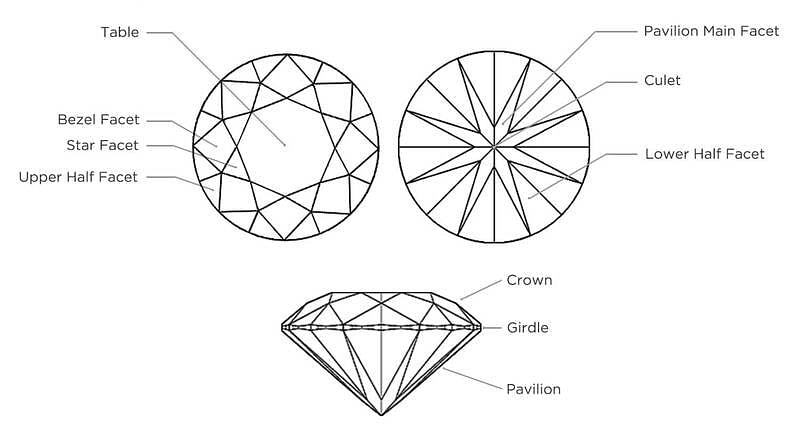
But prior to understanding diamond facets, it is important to establish verse with the basic anatomy of a diamond. A diamond has mainly three structural components – the Crown, the Girdle, and the Pavilion; sometimes, there is a Culet, too. The Crown is the topmost surface of the diamond which is the most visible part from the top and takes up some proportion of the side view too. Then comes the Girdle, which is almost an adjoining structural element between the crown and the pavilion. It is rather a thin line, at some distance from the top, visible only from the side view. The Pavilion is a major structural element that forms the elongated base of the diamond. In a few diamonds, the pavilion culminates at the bottom in a slightly flat base called a culet rather than a pointed one. Now that we understand diamond structure a little better, it will be easier to comprehend facets and their contribution to enriching a diamond’s brilliance.
What is a Diamond Facet?
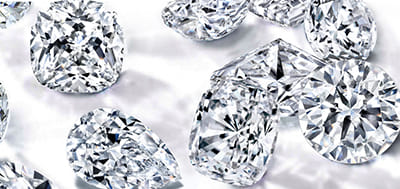
The basic definition of a diamond facet is a flat surface on the geometric shape of the diamond. Several diamond facets together make up the outer surface of the diamond, be it the facets on the crown or the pavilion. Diamond ‘cut’ doesn’t just refer to its shape - it also concerns the diamond facets and how they interact with light. Diamond cutting is both a science and an art. When a diamond is cut to precision by a talented gem cutter in the right dimensions, proportions, and angles, it can completely alter its appearance and luminosity.
The Golden Jubilee diamond, for instance, is the world’s largest faceted diamond, uncovered in 1985 in South Africa. It weighed an estimated 545.67 carats and took several years to cut and polish before being given to the Royal Family of Thailand a decade later. Another famous diamond is the Cullinan I, pear-shaped beauty weighing 530.20 carats that sparkles thanks to its 74 facets. It is on display at the Tower of London.
How Do Facets Impact a Diamond’s Attributes?
Think of diamond facets as windows to let light in and out most effectively. The unique glimmer you see comes from the diamond's innate ability to transmit light intensely. When a diamond’s facets are placed and angled optimally, they maximize the light that shines through, creating three desirable attributes – fire, brilliance, and sparkle. When light enters the diamond, some part of it is reflected out through the table – which is the largest facet, right on top. The rest of the light enters the diamond and bounces off the inside walls. When it finally exits, the white light is separated into beautiful rainbow hues, giving the gemstone its stunning appearance.
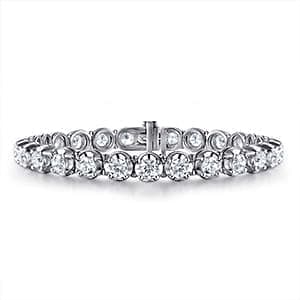
A total of 7.82 ct diamonds of S12 and higher clarity adorn this 14k white gold tennis diamond bracelet. The cut finesse of these round diamonds speaks for itself through the bracelet’s superlative shining appeal.
How are Facets Carved in a Diamond?
Diamond cutters use various hand and machine tools to create desired diamond facets. If you wonder between hands and machine cutting, which produces a better cut diamond, then the answer is both. That said, hand-cutting diamonds is a highly nuanced and skilled craft. It results in world-class diamonds exuding high-end brilliance and scintillation if executed precisely. Since it is a specialized skill, it is concentrated in a few cities around the world - diamond cutting and polishing are executed massively in Surat, India, and the Chinese cities of Guangzhou and Shenzhen.
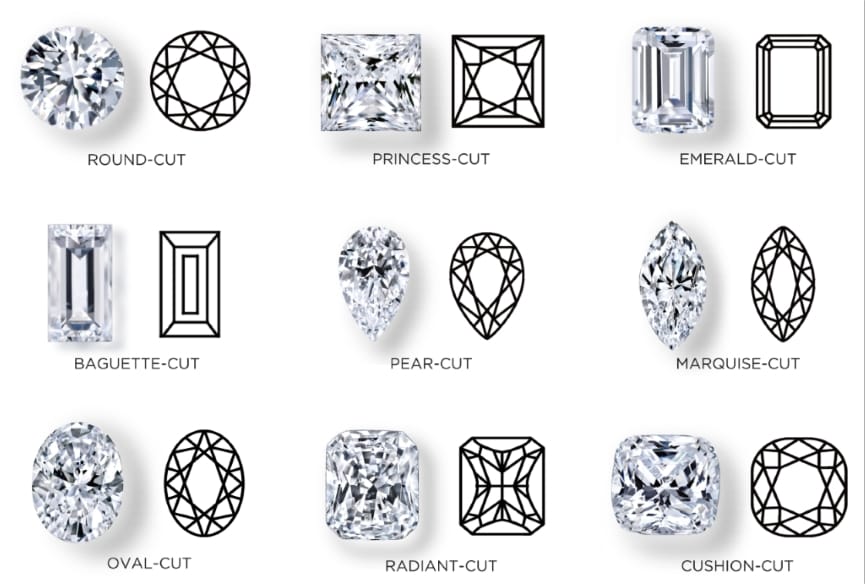
There is no scope for error since diamonds are high-value items, so the first step is using software to plan. This is followed by marking and then finally cutting the diamond using a steel blade or a laser tool. Diamonds are then polished, and specialized artisans add and hone the facets and create the diamond’s brilliance. Quality control is the last and final step.
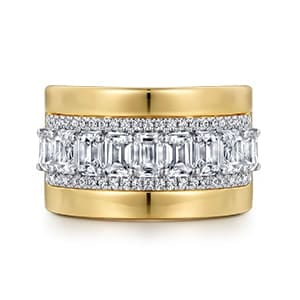
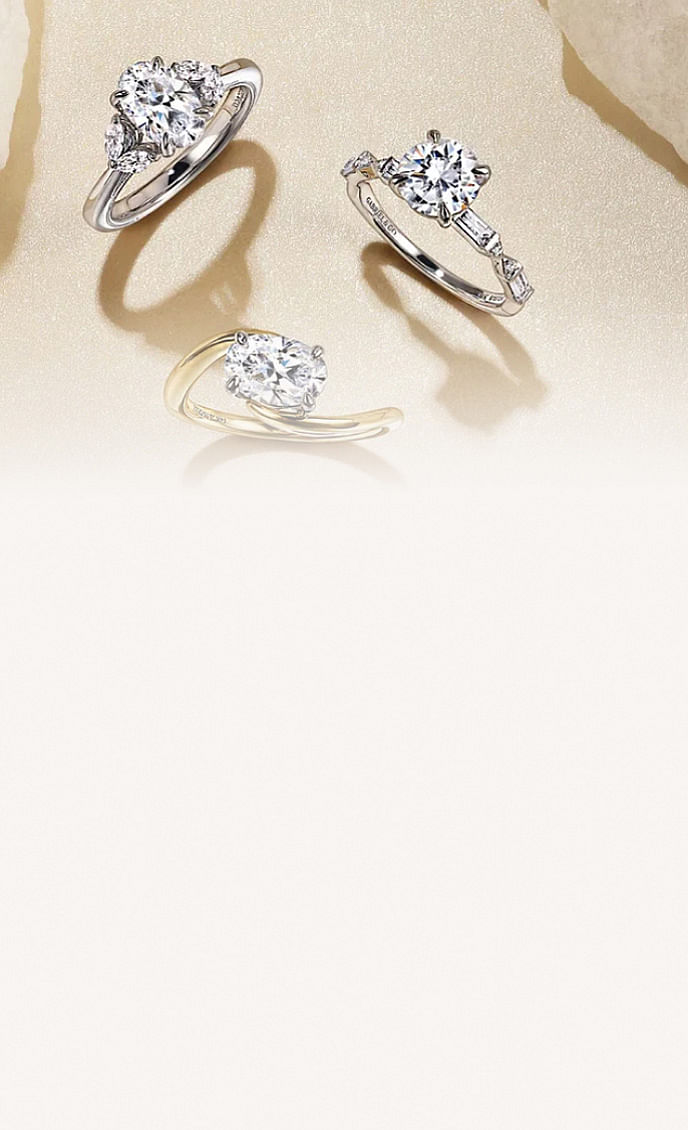
A two-tone women’s ring from our contemporary collection, it is a hard-to-resist jewelry design for any woman. With emerald-cut diamonds taking the center spot, a string of round-cut diamonds enhances the beauty. This stunning ring presents a rare combination of two metal variants – yellow and white gold with two different diamond cuts.
How Many Facets Does Round Cut Diamond Have?
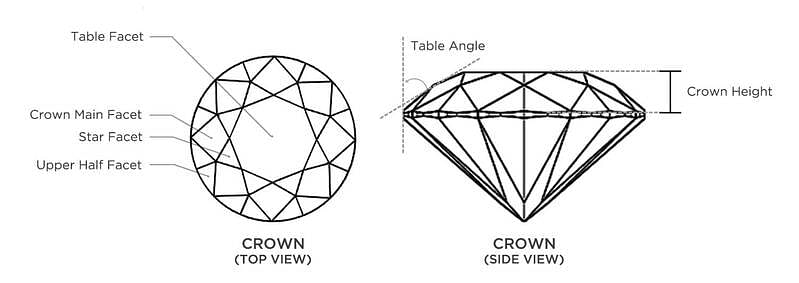
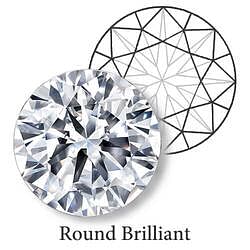
The round-cut diamond is supposed to be the gold standard for using facets effectively. You will find 57 or 58 facets in a standard brilliant round-cut diamond. If a diamond has 57 facets, the crown (the upper part just below the table and until the girdle or the widest point of the diamond) usually has 33. The pavilion (the area underneath the girdle) has 24. Sometimes, the minor point at the bottom is an optional facet on the culet. The crown allows light into the gemstone while the pavilion redirects it to the eye of the diamond viewer.
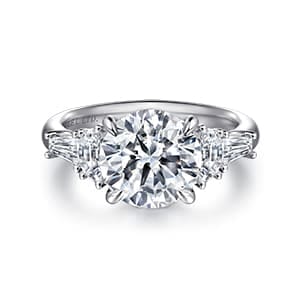
While this 18k white gold engagement ring is love at first sight, it is noteworthy that the five-diamond setting features a 3ct round-cut center diamond and 0.81ct of the rest of the diamonds. The fascinating sparkle makes it the perfect, classic engagement ring to propose with.
Does It Help to Have More Facets of a Diamond?
A larger number of facets do not always mean a perfectly sparkling diamond. Instead, their cut's proportion and symmetry are far more important than the number. Only a skilled and knowledgeable gemstone cutter can ensure that he maximizes the diamond's potential to glitter using facets. Other aspects, like the diamond's depth and width, must also be considered along with the facets to achieve the desired results.
When and Where Did Diamond Facets Originate?
The first diamonds were mined in India, and the primary techniques of cutting and polishing diamonds were also first executed here. Today’s modern-day techniques also use the same best practices of those early times to bring out the most brilliant diamonds in the world. The first idea of using diamond facets to harness light and sparkle began in India around the 6th century. The first diamond achieved through the process was called the ‘point cut’ diamond. It involved creating a point on the diamond using a chisel and with just a few facets – a far cry from the sophisticated cutting techniques of today. In the 14th century, Europeans began to experiment with diamond cuts. In 1477, Mary of Burgundy received a point-cut diamond engagement ring from Archduke Maximilian of Austria, accompanied by thin flat pieces in the shape of an M. From there on, the concept of diamond cuts and facets went on to be explored globally on a massive scale.
What are the Different Types of Diamond Facets?
Diamonds have various facets that contribute to their unique sparkle and brilliance. Some of the key types of diamond facets include:
Table Facet: The flat, top facet of the diamond, serving as a window into the stone.
Crown Facets: These facets are located on the top portion of the diamond, just below the table, and they help capture and reflect light.
Pavilion Facets: Situated on the lower half of the diamond, these facets help direct light towards the crown, enhancing the diamond's overall sparkle.
Star Facet: These small facets near the girdle (the diamond's outer edge) help disperse light evenly across the surface.
Kite Facet: These are typically found in fancy-shaped diamonds like princess or radiant cuts, contributing to their unique brilliance.
Girdle Facets: These are found on the diamond's girdle and may vary in number depending on the cut.
Culet Facet: Located at the bottom tip of the diamond (the culet), this facet helps protect the diamond from damage and may or may not be present, depending on the cut.
Lower Girdle Facets: These facets connect the pavilion and girdle, assisting in light reflection and dispersion.
Visit our website, gabrielny.com, to explore an awe-inspiring collection of jewelry designs across styles, boasting high-quality diamonds that have been caressed by the hands of remarkable diamond craftsmen around the world.