Good to Have You Back

Necklaces are one of the most versatile pieces of jewelry you can own. They can dress up a plain tee or elevate a formal gown, and the right one can become a signature piece you reach for again and again. But with so many styles on the market, it helps to actually know what you're looking at before you buy. Here's a breakdown of the types of necklaces, what makes each one distinct, and where each one shines.
The 12 Types of Necklaces and Their Subcategories
Chain Necklaces

Chain necklaces are the foundation of fine jewelry, a simple, continuous series of connected links that can be worn on its own or as the backbone for a pendant. The design of the individual link is what separates one chain style from another, and each has its own character.
- Cable chain: The classic, round or oval link pattern; simple, sturdy, and the most common base for pendants
- Curb chain: Flattened, interlocking links that lie smoothly against the skin; a popular choice for a more substantial, masculine look
- Figaro chain: A pattern of alternating small and large links, traditionally Italian in origin
- Box chain: Square-shaped links that create a sleek, sturdy, almost seamless-looking chain
- Rope chain: Links twisted together in a spiral, mimicking the look of a twisted rope
- Snake chain: Tightly connected, flexible plates that give the chain a smooth, snake-like flow with no visible individual link
- Herringbone chain: Flat, closely woven links that create a ribbon-like, high-shine surface
- Byzantine chain: An intricate, ornate weave of interlocking links, often associated with bolder, more decorative pieces
Pendant Necklaces
A pendant necklace pairs a chain with a hanging charm or focal piece, making it one of the most personal and customizable categories. The chain is really just the delivery system; the pendant is the star.
- Solitaire pendants: A single gemstone or diamond as the focal point
- Initial/letter pendants: An initial necklace features a monogram or single letter, popular for personalized gifting
- Birthstone pendants: Featuring a gemstone tied to a birth month, often chosen for sentimental or gifting occasions
- Religious and symbolic pendants: Cross necklaces, Stars of David, hamsas, evil eye charms, and other meaningful symbols
- Dainty pendants: Small, dainty necklaces meant to be worn subtly or layered with other pieces
- Charm pendants: often symbolic charm necklaces, like animals, hearts, zodiac signs, or icons, that can be worn individually or collected and layered together over time
Choker & Collar Necklaces
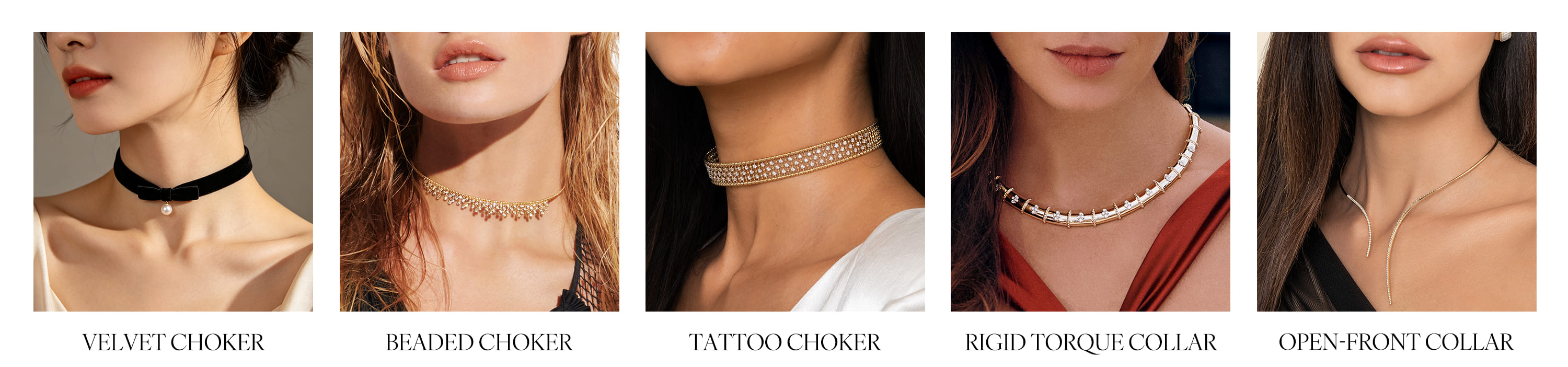
Collar and choker necklaces both sit high on the neck, and the two terms are often used interchangeably, but there's a subtle difference worth knowing. A collar necklace is the tighter, higher-sitting of the two, typically wrapping right at the base of the neck and often built as a rigid or wide band, sometimes with an open front. A choker sits just below that, with slightly more room to move, and tends to be more flexible in material.
- Velvet choker: A soft ribbon-style choker, often with a pendant or charm
- Beaded choker: Multiple strands of small beads or pearls worn snug to the neck
- Tattoo choker: A delicate, often lace-like design that sits close to the skin
- Rigid torque/collar: A solid metal band, sometimes with an open front, that keeps its shape
- Open-front collar: A structured collar with a gap at the front, often finished with decorative ends
Statement Necklaces
When a necklace is meant to be the focal point of an outfit rather than a supporting accessory, it falls into the statement category. Statement necklaces are typically bolder and more eye-catching than everyday styles, though the "statement" doesn't always come from size. Sometimes it's the design itself doing the talking.
- Bib necklaces: A wide, layered design that covers the upper chest like a bib
- Collar-style statement pieces: An oversized, decorative take on the collar silhouette
- Pavé/encrusted designs: Necklaces densely set with small stones for maximum sparkle
- Sculptural designs: Bold, artistic shapes and forms where the statement comes from the design itself rather than the necklace's size
Pearl Necklaces
Pearl necklaces are their own category entirely, prized for their classic appeal and the fact that they never really go out of style. Unlike most other necklace types, pearls are typically defined less by a specific design and more by how they're strung and worn, since a strand of pearls can look completely different depending on its length, whether it's layered with other strands, and how snug or loose it sits. That versatility is part of why pearls work for nearly any occasion, from a single strand paired with a simple blouse to a multi-strand look for a special event.
- Strand necklaces: A single continuous line of pearls, the most traditional pearl style
- Princess-length pearls: Pearls strung to sit at the collarbone, the most versatile everyday length
- Multi-strand pearls: Two or more strands worn together for a fuller look
- Pearl chokers: Pearls strung short and snug against the neck
Beaded Necklaces
Beaded necklaces use strung beads, whether gemstone, glass, wood, or mixed materials, as the primary design element rather than a metal chain. The appeal is largely in the natural variation of the stones themselves, since no two beads are ever quite identical, giving each necklace its own character. Our collection includes beads cut from stones like onyx, lapis, malachite, spinel, moonstone, blue topaz, white sapphire, and red agate, often paired with 14K yellow gold or sterling silver. Some designs also combine beaded strands with our signature Bujukan gold spheres or diamond accents for a mix of texture and sparkle.
- Gemstone bead strands: Beads cut from natural stones like turquoise, lapis, or amethyst
- Mixed-material beaded designs: Combinations of metal, gemstone, and other beads for texture and color variation
Station Necklaces
A station necklace features a delicate chain with gemstones, beads, or small motifs spaced evenly along its length. It's a subtle way to add sparkle without the weight or cost of a fully set piece. Because the accents are spaced rather than clustered, station necklaces tend to read as understated and wearable every day, while still catching the light in a way a plain chain doesn't. They also layer beautifully, since the delicate chain and evenly spaced detail don't compete with other pieces worn alongside them.
- Diamond-by-the-yard style: Small diamonds set at intervals along a fine chain
- Gemstone station: Colored stones spaced along the chain instead of diamonds
- Motif station: Small repeating shapes, like hearts or stars, spaced along the chain
Lariat/Y-Necklaces
Lariat necklaces use the drop of the necklace itself as the design feature, rather than distributing weight evenly around the neck. Without a traditional clasp, a lariat gives you more freedom in how you wear it: wrapped once for a shorter look, knotted for texture, or left to drape long for a more relaxed silhouette. The Y-necklace takes a related idea and gives it more structure, with the chain narrowing down to a single point so the eye is drawn straight to the pendant or drop at the end, making it a natural fit for V-neck and scoop-neck tops.
- Open-ended lariats: A necklace with no clasp, designed to be wrapped, knotted, or draped
- Y-drop necklaces: A chain that narrows into a single point, forming a "Y" shape
Layered/Multi-Strand Necklaces
Layering has become one of the most popular ways to wear necklaces, turning a single chain into a fuller, more personalized look. There are really two ways to get there: you can layer pieces yourself, mixing metals, pairing a delicate chain with a pendant, or stacking varying lengths and textures for a look that feels curated rather than matched, or you can reach for a layered necklace that's already designed to do the layering for you. That second option is what the styles below cover, pieces built specifically so you get the layered effect in one wear.
- Curated layered sets: Necklaces sold or designed as a matched set meant to be worn together
- Graduated multi-strand: Multiple strands of increasing length worn at once for a built-in layered effect
- Tassel necklaces: Finished with a tassel or fringe drop at the end.
Locket Necklaces
Locket necklaces combine sentimentality with function: a pendant that opens to hold a photo, memento, or small keepsake. What sets a locket apart from other pendants is that hidden compartment, which turns the necklace into a way to carry a loved one close, making it a popular gift for milestones like birthdays, graduations, and new babies. Today's lockets also range well beyond the classic antique look, from traditional hinged designs to sleek, minimalist takes.
- Traditional lockets: Classic hinged designs, often oval or heart-shaped
- Modern photo lockets: Updated takes on the locket, including digital or minimalist designs
Tennis Necklaces
Named after the continuous line of stones of tennis bracelets, a tennis necklace applies the same concept to the neckline: a seamless row of gemstones or diamonds set in a flexible chain. The name traces back to a famous moment on the tennis court when a player's diamond bracelet came loose mid-match, and play stopped until it was found, and the name stuck ever since. What makes the style so enduring is the sheer amount of sparkle it delivers in a relatively slim, streamlined design, since the stones run continuously rather than being spaced out or clustered. It's a piece that reads as effortlessly dressy, equally at home worn alone for a polished everyday look or layered with other necklaces for something bolder.
- Diamond-line tennis necklaces: An unbroken row of diamonds
- Gemstone-line tennis necklaces: The same continuous-line design using colored stones
Bar Necklaces
Unlike a pendant, which hangs and moves, a bar necklace holds its shape: a straight, horizontal bar that sits flat and static against the chest rather than dangling. That fixed, clean line is what gives bar necklaces their minimalist, modern look, and it's also what makes them such a popular canvas for personalization, since a flat surface is easy to engrave with a name, initials, coordinates, or a short word or phrase.
- Engraved bar necklaces: Personalized with a name, word, date, or coordinates
- Plain bar necklaces: A simple polished or textured bar with no engraving, worn for its clean, minimal look
- Embellished bar necklaces: A bar accented with diamonds or gemstones, either scattered across it or set at one end
Necklace Lengths
Style is only half the equation. Length changes how any of the categories above will actually sit and look, from a snug collar to a long rope you can double-wrap. For a full breakdown of every length, where each one sits, and how to choose based on your neckline and body type, check out our dedicated guide:
How to Choose a Necklace
At the end of the day, there's no single "right" necklace, but a few things can help you narrow down what will actually work for you.
Metal tone
Start with your metal tone. Think about your skin's undertone and what you already reach for in your jewelry box. If you tend to look best in warm tones, yellow or rose gold is probably going to feel more natural than it does forced. Cooler undertones, on the other hand, usually lean toward white gold or platinum.
Neckline
Then think about what you're wearing it with. Necklines have a way of dictating what looks intentional versus what looks like an afterthought. A crew neck has the space for a longer pendant or a lariat to do its thing. A V-neck practically asks for a Y-necklace, since the shape just continues the line the neckline already started. And if you're in something strapless or off-the-shoulder, that's your cue to let a statement piece or a collar necklace take center stage instead of getting lost.
Occasion
Occasion matters too, though maybe not as much as we sometimes think. A delicate chain or a small pendant is the kind of thing you can wear every day and forget you have on, which is exactly the point. Save the tennis necklace, the layered pearls, or the true statement pieces for the moments that call for a little more presence.
Personal style
Once you've thought through all of that, the last filter is the most important one: does it feel like you? These categories are a helpful starting point, not a rulebook. The necklace you'll actually reach for is the one you love wearing, not just the one that checks every box.
For more insights on how to choose the right necklace for your outfit, read our dedicated blog
Final Thoughts
From delicate chains to bold statement pieces, every necklace category has its own personality and often, its own occasion. Understanding the differences between these styles makes it easier to build a collection that works together.
FAQs
Frequently Asked Questions
What's the difference between a choker and a collar necklace? ⌄
What's the difference between a pendant necklace and a locket necklace? ⌄
What's the difference between a lariat and a Y-necklace? ⌄
What is a station necklace? ⌄
Can I wear different necklace types layered together? ⌄
What's the best necklace for everyday wear? ⌄
How do I know what necklace length to choose? ⌄