What to Consider When Choosing a Wedding Ring
Everything our bridal team weighs before recommending a wedding ring, from diamond grading and metal sourcing to fit, construction, and what protects the purchase for the next fifty years.
A wedding ring is one of the only pieces of fine jewelry most people wear every single day for the rest of their lives, which makes it a very different purchase from an engagement ring, a gift, or a special-occasion piece. It has to hold up to dishwashing, workouts, keyboards, and decades of wear, while still feeling and looking exactly right.
Choosing one well means weighing diamond and gemstone quality, metal type, comfort, construction, documentation, and budget together, rather than focusing on any single detail. Here's what actually matters at each stage of that decision.
Diamond and Gemstone Quality
What grading actually tells you, and where it matters less than you'd think.
The quality of a diamond or gemstone in a wedding ring comes down to two things: how it's graded, and how well its cut and setting hold up to daily wear. A ring can look flawless in the store and still disappoint years later if either of those was overlooked.
Understanding GIA Verification
GIA (the Gemological Institute of America) is the independent, non-profit grading standard the jewelry industry treats as the benchmark for diamond authenticity and quality. Diamonds verified through GIA methodology are confirmed as natural, non-treated stones: not lab-grown or simulated, and not undisclosed enhancements. In practice, this works two ways: larger center stones typically come with an individual GIA grading report detailing the 4Cs, while the small pavéPavé is a setting style where small diamonds are set closely together across a surface, held by tiny beads of metal, so the metal itself nearly disappears. and meleeMelee refers to small diamonds, typically under 0.18 carats, used as accents rather than as a center stone. diamonds used as accents are checked in bulk through GIA-developed automated screening technology that confirms natural origin. Every diamond used across Gabriel & Co. designs is GIA verified as a natural diamond, and that verification is recorded on the piece's digital Certificate of Authenticity. When comparing wedding rings, always ask specifically how, and whether, the diamonds have been verified; "certified" and "verified" get used loosely, and the distinction matters more than it should have to.
Cut, Color, Clarity, and Carat: What Actually Matters for Daily Wear
The 4Cs (cut, color, clarity, carat) still apply to wedding rings, but their relative importance shifts once a stone is going to be worn every day rather than admired in a solitaire setting. A few practical rules:
- Cut: matters most, at any size. It's the difference between a diamond that reads bright and lively and one that looks flat, regardless of grade on paper.
- Color and clarity: can flex lower for small accent stones without a visible difference to the naked eye. This is where a lot of sensible savings happen.
- Carat weight: should be balanced against setting security. A larger stone in a low-profile daily-wear band needs a protective setting more than it needs an extra fraction of a carat.
The honest takeaway: for a ring you'll wear every day, durability-minded cut and setting choices generally matter more than chasing the highest grade on a lab report.
Find Your Match
Not sure which band from this guide is right for you? Answer a couple of quick questions and we'll show you real pieces worth a closer look.
Which metal are you drawn to?
Plain and simple, or set with diamonds?
‹ BackWhat's the vibe you're after?
‹ BackA classic straight band, or one built to curve and stack with an engagement ring?
‹ BackPick your sparkle style.
‹ BackWhat kind of stacking design?
‹ BackMetal Type and Sourcing
The metal you choose shapes everything from upkeep to environmental impact.
Metal choice affects everything from day-to-day durability to long-term maintenance to environmental impact, and increasingly, sourcing is as much a part of "quality" as karat weightKarat measures gold purity (24 karat is pure gold). It's a different measurement from carat, which measures a diamond's weight..
Recycled Gold vs. Virgin Gold
Recycled gold is gold that has already been mined, refined, and used, then reclaimed and re-refined to the same purity as newly mined ("virgin") gold. There is no performance difference: recycled 14K gold is exactly as durable, workable, and long-wearing as virgin 14K gold, because at the refining stage the metal is chemically identical. The difference is entirely upstream, in the environmental footprint of not mining new ore. Gabriel & Co. now sources the majority of its bridal and fashion jewelry from Responsible Jewelry Council-certified recycled gold, alongside a broader commitment to conflict-free, Kimberley ProcessAn international certification scheme that tracks diamonds from mine to market to keep conflict diamonds out of the legitimate supply chain.-compliant sourcing. If sustainability is part of your decision, it's worth asking any brand directly what percentage of their gold is recycled: the answer varies widely across the industry.
Choosing Between White Gold, Yellow Gold, Rose Gold, and Platinum
Each metal wears differently over a lifetime, not just at the counter:
What matters most to you?
| Metal | Look | Durability & upkeep |
|---|---|---|
| Yellow gold | Warm, traditional | Softer than platinum; shows a patinaA patina is the soft, matte sheen a metal develops on its surface from years of gentle everyday wear. over decades that many wearers like; easy to resize |
| White gold | Bright, cool-toned | Rhodium-platedRhodium is a bright white metal plated over white gold to give it extra shine and a brighter white tone. for shine; typically needs re-plating every 1 to 2 years |
| Rose gold | Warm pink, romantic | Copper alloy makes it notably hard and scratch-resistant; low maintenance |
| Platinum | Naturally white, dense | Densest and most hypoallergenic option; develops a soft patina instead of scratching away; costs more by weight |
There's no universally "best" metal, only the best match for a wearer's skin sensitivity, maintenance tolerance, and how much natural aging they want their ring to show.
‹ ›
Fit and Comfort for Everyday Wear
The difference between a ring you love and one you keep adjusting.
A ring that photographs beautifully but pinches, spins, or catches on everything for the next fifty years was the wrong ring. Fit deserves as much attention as design.
Band Width and Shank Thickness
Band width generally runs from about 2mm up to 7mm, and where a ring falls on that range shapes both the look and the everyday feel of it:
- 7mm: bold and statement-making, the most substantial presence on the hand.
- 6mm: strong and substantial, still bold but a touch lighter.
- 5mm: balanced and versatile, a common middle ground.
- 4mm: classic and comfortable, easy to wear all day.
- 3mm: slim and understated, leaning toward a delicate look.
- 2mm: delicate and minimal, the lightest and least noticeable option.
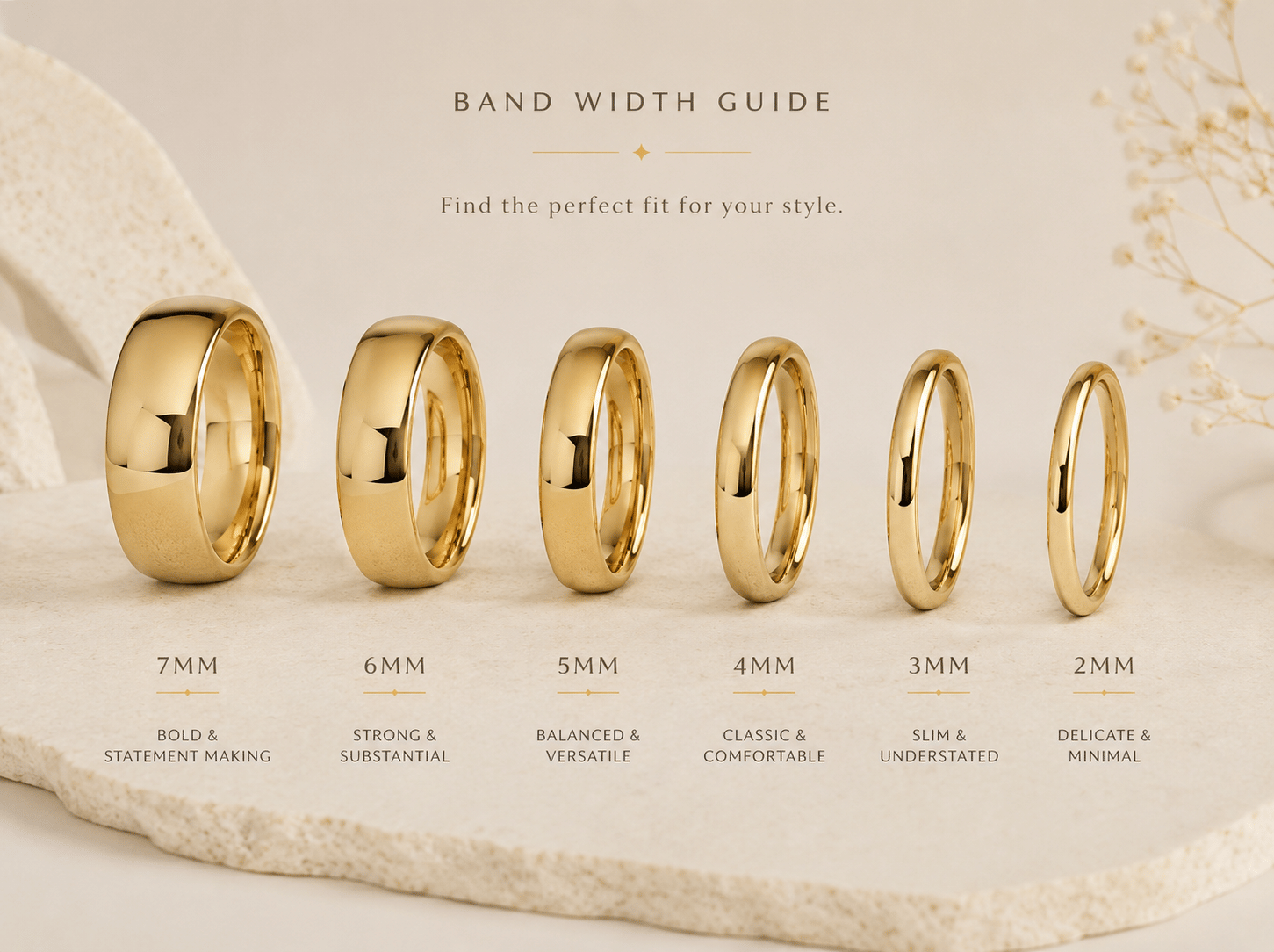
Wider bands (roughly 5 to 7mm) also tend to be more resistant to bending, though they cover more of the finger and can feel bulky on smaller hands or during manual work. Narrower bands (2 to 4mm) feel lighter and more discreet but may need a slightly higher karat or reinforced profile to resist bending over time. Shank thickness (how much metal sits between the finger and the outside of the ring) is a separate, more overlooked factor: a thin shank in a soft metal is the most common reason a wedding band eventually needs reshaping, regardless of its overall width.
Stacking with an Engagement Ring
Bands meant to sit flush against an engagement ring are built in a handful of distinct shapes, and each one solves a different fit problem depending on the engagement ring it's paired with. Knowing the difference makes it much easier to shop for a band that will actually sit flush, rather than gap or twist against the ring you already wear.
- Plain wedding bands: a simple, uniform ring of metal with no curve, notch, or gap built into the shape. Because there's no profile to match, they pair with almost any engagement ring by default, which is exactly why they're the most common choice for anyone who isn't sure yet what their engagement ring will look like, or who wants the two rings to read as separate pieces rather than a fitted set. Shop plain wedding bands.
- Curved bands (Gabriel & Co. also calls this style a notched, chevron, or V band): a gentle curve or V-shaped indent along one side that follows the outline of a center stone, rather than being molded to one specific ring model. That makes them more flexible than a true contour band. They pair best with classic solitaire or halo engagement rings that have a prominent center stone sitting above the band, since the curve tucks neatly around the stone or prongs without needing an exact style match. Shop curved wedding bands.
- Open bands: leave a deliberate gap in the circle, sometimes a small space, sometimes framed with diamonds or a decorative motif on each end, instead of forming a closed loop. They pair best with fancy-shaped center stones (oval, pear, marquise, emerald cut) and east-west engagement rings, since the negative space frames the outline of the stone instead of crowding it. They also layer well as an additional anniversary band later on. Shop open wedding bands.
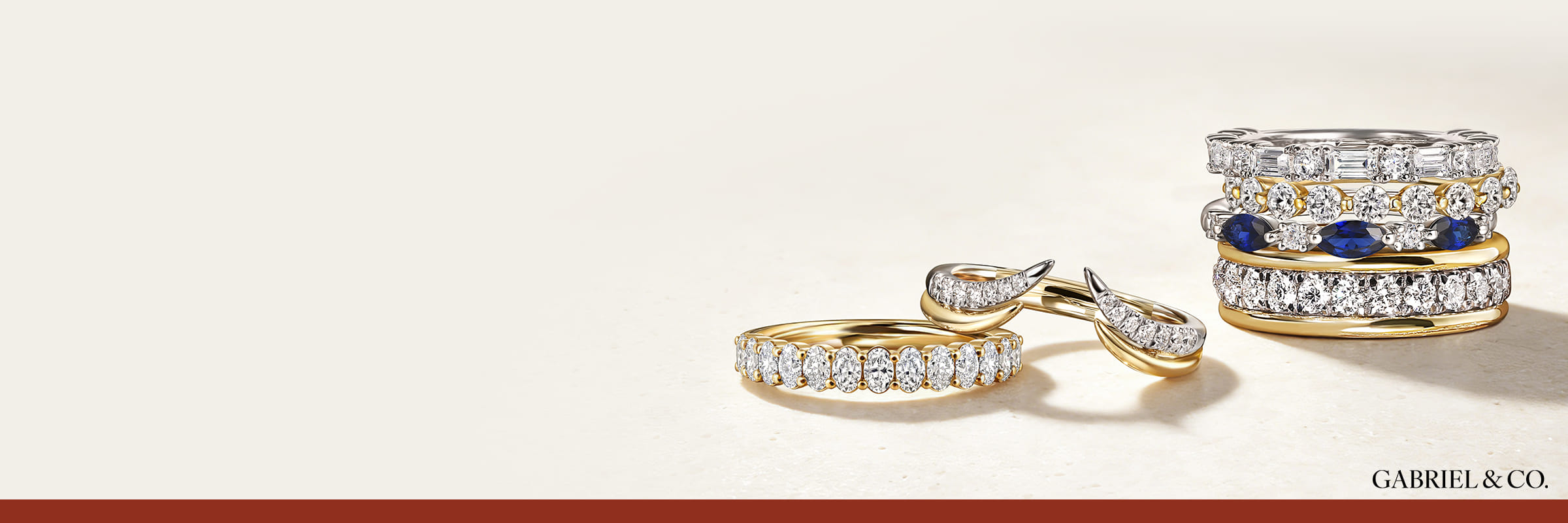
- Stackable wedding rings: thin, evenly shaped bands built to be layered rather than shaped around one engagement ring's negative space. They pair best with simple solitaire engagement rings and with each other, since they're designed to be added to over the years (an anniversary band, a push present) without needing to match a single profile. Shop stackable wedding rings.
- Ring enhancers (sometimes called ring guards): wrap around an engagement ring you already own, rather than being purchased as a separate band to sit beside it. They pair best with any solitaire or simple engagement ring you want to visually update, since the enhancer effectively becomes a halo or second band around the existing setting. Shop ring enhancers.
Note
This isn't an exhaustive list, and it doesn't mean every other band style is off-limits for stacking. These five shapes are simply the ones people gravitate toward first, because they tend to sit flush against an engagement ring with the least adjustment. A wider or more intricately designed band, once fitted and set at the right height, can create just as beautiful a stack, sometimes a more distinctive one. The real test isn't the category label; it's whether the band clears the engagement ring's setting and sits flush once the two are tried on together.
Band Finder
Answer two quick questions and we'll point you to the shape that fits your situation.
What's the situation?
How do you picture wearing it?
‹ BackWhat best describes the engagement ring's center stone or setting?
‹ BackSizing and Resizing Considerations
Finger size fluctuates with temperature, time of day, and life changes, so it's worth getting sized later in the day and avoiding sizing right after intense heat or cold exposure. A few structural realities worth knowing before you buy:
- Wider bands and heavily patterned or textured designs are generally harder, and sometimes impossible, to resize without disrupting the design.
- Eternity bands (with stones set continuously around the entire circumference) typically cannot be resized at all, since resizing would mean cutting through set stones.
- Half-eternity or channel-set bands with plain metal at the back usually can be resized within a modest range.
If there's any chance your ring size will change, ask specifically about resizing limits before you buy, not after.
Setting and Construction
Where a wedding ring's real durability gets decided.
How stones are set, and how a band is built underneath the design you see, is where a wedding ring's long-term durability is actually decided.
Prong, Bezel, and Channel Settings
- Prong settings: use small metal claws to hold a stone while exposing it to maximum light: brilliant, but the most exposed to snagging and chipping over daily wear.
- Bezel settings: surround the stone in a continuous metal rim, protecting the edges entirely. This is the most durable option for hands-on lifestyles, at a slight cost to how much light reaches the stone.
- Channel settings: set stones flush between two metal walls, creating a smooth, snag-free surface. This is one of the most common approaches for wedding bands specifically, because there's nothing raised to catch on gloves, keyboards, or fabric.
Cathedral and Bridge Details
A cathedral setting uses arched shoulders that sweep upward toward a center stone or motif, similar to the lines of a cathedral window, a detail more common on cathedral engagement rings but often echoed in the shoulders of a matching band. "Bridge" details refer to the design element that connects a raised motif to the shank underneath it; in contour and shadow bands designed to sit against an engagement ring, the bridge is what keeps that connection structurally sound rather than just visually implied. These details add character, but they also add places where the design narrows, worth a close look for anyone whose hands take a lot of daily impact.
Hand-Finishing and Durability
Casting and setting a ring is only part of the process; hand-finishing (polishing, smoothing interior edges, and checking symmetry by eye and by hand) is what determines whether a ring feels comfortable against skin for decades rather than just looking finished on day one. Gabriel & Co.'s in-house artisans oversee design, manufacturing, polishing, and distribution under one roof, which keeps quality control consistent across a piece's full production, rather than handed off between unrelated third parties at each stage.
‹ ›
Customization
Most of what feels custom is already built into the design.
A wedding band rarely needs to be entirely custom-made to feel personal. Most of the meaningful decisions happen within the options a design already offers.
Adjusting Carat Weight and Metal
Many wedding band styles are offered across multiple metals (Gabriel & Co. designs commonly come in two, three, or four metal options within the same style), as well as a range of total diamond carat weight within the same design. That means the same silhouette can often be adjusted up or down in stone size, or moved between gold, platinum, and two-tone options, without starting from a blank design. An authorized retailer can usually special-order a style in a metal or carat weight not currently in stock.
Matching a Band to an Existing Engagement Ring
Beyond contour matching (covered above), customization here often means adjusting a stackable band's metal or stone placement so it complements, rather than competes with, an engagement ring's existing design language. Bringing a photo and the style or SKU number of the engagement ring to an appointment makes this a much faster process than describing it from memory.
Documentation and Warranty
The paperwork that protects the purchase for the next fifty years.
Paperwork isn't the exciting part of buying a wedding ring, but it's what protects the purchase for the next fifty years, and it's worth understanding before you buy, not after something goes wrong.
Certificate of Authenticity and Serial Number
Each Gabriel & Co. piece carries a unique serial number tied to a digital Certificate of Authenticity, which documents the piece's GIA diamond verification and permanently connects it to its original registration. That serial number is also the mechanism that activates warranty coverage, so it's worth treating the certificate as a document to keep, not just a nice-to-have.
What a Limited Warranty Covers
Gabriel & Co.'s warranty program covers manufacturing defects for the life of the piece, plus normal wear-and-tear and accidental damage for one year from the date of purchase. Coverage isn't automatic: it requires registering the piece within 30 days of purchase using its unique serial number and original sales receipt. Skipping registration is the single most common reason wedding ring owners later find out their piece isn't covered. Set a reminder if you need to.
Budget and Value
Where to spend, and where it's smart to hold back.
Price on a wedding ring is rarely just "the diamond" or just "the gold." It's the sum of several decisions, some of which are worth paying more for and some of which aren't.
What Drives Price in a Fine Wedding Ring
Four factors do most of the work in determining price:
- Metal type and weight: platinum and heavier bands cost meaningfully more than lighter gold bands.
- Diamond or gemstone quality and total carat weight: this is usually the single largest swing factor.
- Setting complexity: channel and pavé work takes more labor than a simple prong or plain band.
- Craftsmanship and finishing: hand-finishing and in-house quality control add cost, but also add the durability discussed above.
As a general guide, well-made wedding bands from established bridal brands tend to start in the low thousands and move well past that for platinum or higher-carat designs, though this varies enough by retailer and design that it's worth treating as a starting orientation rather than a fixed number.
Where to Invest vs. Where to Save
Because a wedding band gets worn every day for decades, the areas worth prioritizing are the ones that affect longevity: metal purity and durability, setting security, and verified diamond quality. Areas where it's genuinely reasonable to save include: choosing a lower carat weight on accent stones, opting for a simpler setting over an elaborate one, or choosing yellow or rose gold over platinum if hypoallergenic properties aren't a personal requirement. The mistake to avoid is the reverse: saving on construction and setting security to afford a bigger center stone on a ring that's going to see forty years of daily wear.
Why Choose Gabriel & Co.
Nearly four decades of bridal jewelry, made to be worn.
Gabriel & Co. has designed bridal and fashion jewelry out of New York since 1989, and the brand's approach to wedding rings reflects a few consistent commitments: every diamond is GIA verified as natural; sourcing follows Kimberley Process conflict-free standards, with the majority of bridal gold now Responsible Jewelry Council-certified recycled gold; and production stays in-house from design through hand-finishing, rather than split across outside contractors.
Every piece ships with a unique serial number and digital Certificate of Authenticity, and registering that serial number activates a warranty covering manufacturing defects for life, plus a full year against wear and accidental damage. The result is a wide range of wedding rings, from classic to distinctive, built to be sized, stacked, and worn for a lifetime, not just photographed on the way out of the store.
Frequently Asked Questions
How can I tell if a diamond in a wedding ring is real and certified?
Ask the retailer specifically how the diamonds were verified, not just whether they're certified. Larger center stones typically come with an individual GIA grading report covering the 4Cs. Smaller pavé and melee accent diamonds are usually confirmed through automated GIA-developed screening technology that checks for natural origin in bulk. Every diamond used across Gabriel & Co. designs is GIA verified as a natural diamond, and that verification is recorded on the piece's digital Certificate of Authenticity.
Which metal is best for a wedding band: white gold, yellow gold, rose gold, or platinum?
There's no single best metal, only the best match for your lifestyle. Platinum is the densest and most hypoallergenic option but costs more by weight. White gold needs rhodium re-plating every year or two to stay bright. Rose gold's copper alloy makes it notably scratch-resistant. Yellow gold is the softest of the four but the easiest to resize and the most traditional in appearance.
Is recycled gold as strong and durable as newly mined gold?
Yes. Recycled gold is refined to the same purity as newly mined gold, so a recycled 14K band performs identically to a virgin 14K band in strength, workability, and how it wears over time. The only difference is upstream: recycled gold avoids the environmental footprint of new mining. The majority of Gabriel & Co.'s bridal jewelry is now made with Responsible Jewelry Council-certified recycled gold.
Can a wedding band be resized after purchase?
Most simple bands can be resized within a modest range. Wider bands, heavily textured designs, and full eternity bands with diamonds set continuously around the entire ring are harder, and sometimes impossible, to resize without disrupting the design or cutting through set stones. Ask about resizing limits before you buy, especially if your ring size may change.
What's the difference between a prong, bezel, and channel setting?
A prong setting uses small metal claws that expose a stone to maximum light but leave it more exposed to snagging. A bezel setting surrounds the stone in a protective metal rim, making it the most durable choice for active hands. A channel setting holds stones flush between two metal walls, creating a smooth surface that won't catch on gloves, keyboards, or fabric, which is why it's common on wedding bands specifically.
Can a wedding band be customized in a different metal or carat weight?
Often, yes. Many Gabriel & Co. wedding band styles are already offered in two, three, or four metal options within the same design, along with a range of total diamond carat weight. An authorized retailer can typically special-order a style in a metal or carat weight that isn't currently in stock.
What does Gabriel & Co.'s warranty cover, and how do I activate it?
The warranty program covers manufacturing defects for the life of the piece, plus normal wear-and-tear and accidental damage for one year from the purchase date. It only activates once you register the piece within 30 days of purchase using its unique serial number and original sales receipt.
How much should I expect to spend on a fine wedding ring?
Price is driven mainly by metal type and weight, diamond or gemstone quality and carat weight, setting complexity, and hand-finishing labor. As a general guide, well-made wedding bands from established bridal brands tend to start in the low thousands and move well past that for platinum or higher-carat designs, though this varies enough by retailer and design to treat as an orientation rather than a fixed number.
Start With What Matters Most
Grading, metal, fit, and construction will always matter more than any single design trend. Keep those in mind while you shop, and the right wedding ring becomes a much easier decision.