Engagement Ring Eras Explained
Four periods, four love stories written in gold and gemstones. Here's the real history behind the vintage-inspired engagement ring styles everyone's searching for, told the way a jewelry historian would tell it, not a listicle.
In This Guide
Every engagement ring era was really a response to something: a queen's heartbreak, a new torch that let goldsmiths do the impossible, a tomb cracked open after 3,000 years, a war that made platinum illegal to buy. Once you know what was happening in the world when an engagement ring was made, you stop seeing "vintage style" as a mood board and start seeing it as a fingerprint. You can look at an engagement ring and know almost exactly what decade it came from, and why it looks that way.
We're walking through this in the order it actually happened, because the story only makes sense chronologically: each era was, quite literally, a reaction to the one before it. Victorian sentimentality gave way to Edwardian restraint, which was interrupted by Art Deco's total rejection of the past, which was interrupted again by a literal world war. All four eras inspire the vintage engagement rings in our collection, so you'll find Victorian-inspired, Edwardian-inspired, Art Deco-inspired, and Retro-inspired engagement rings along the way.
Victorian
1837 – 1901Romance you were supposed to decode, not just admire.
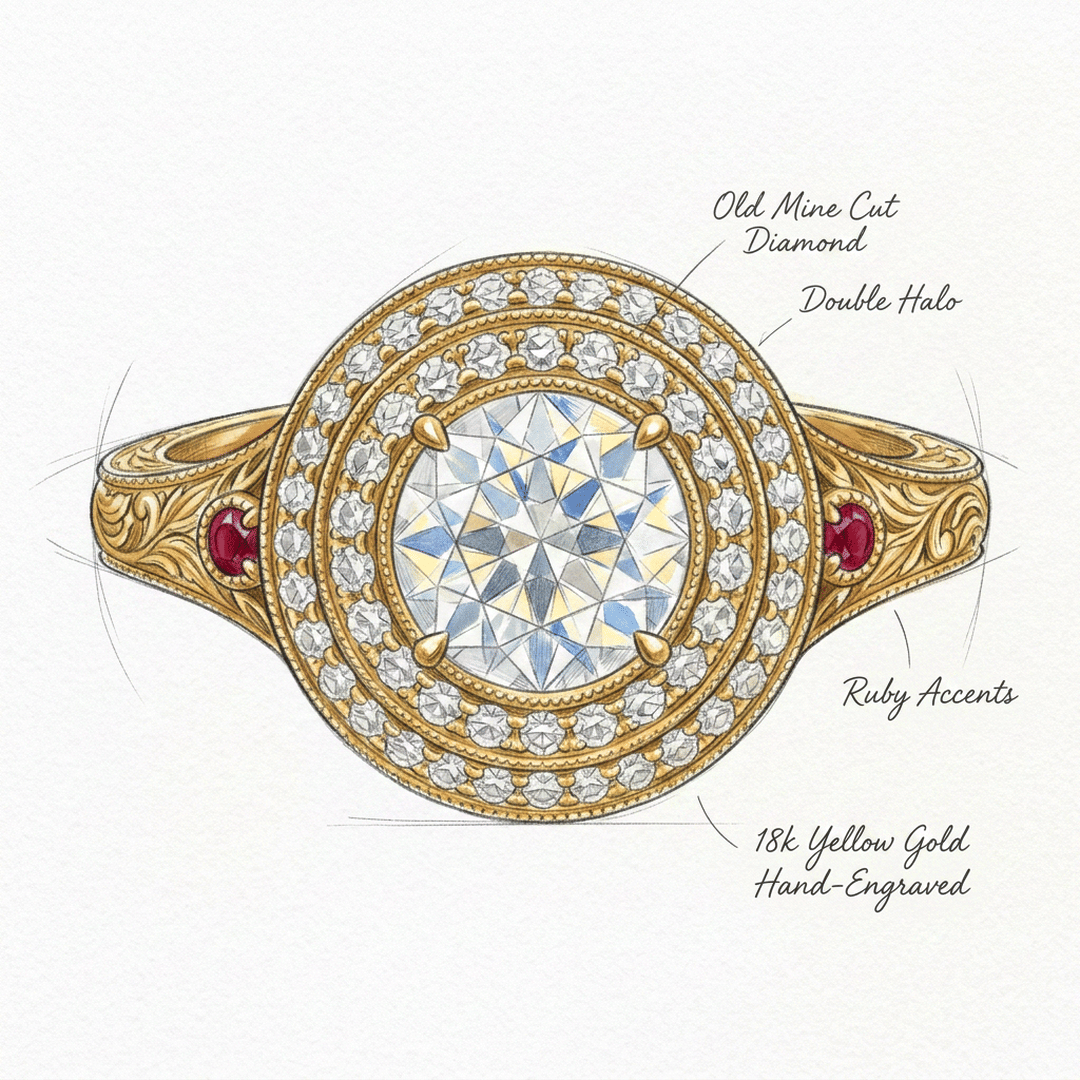
Named for a 63-year reign, Victorian rings actually split into three distinct moods as the era matured: the sentimental Romantic period, the darker mourning-driven Grand period after 1861, and the lighter, more delicate Aesthetic period at the end of the century. What ties them together is that Victorian jewelry was rarely just decorative: it was a language.
The queen who proposed with a snake
In 1839, Prince Albert gave then-Queen Victoria a ring shaped like a coiled serpent, its tail held in its mouth to form an unbroken circle, with an emerald-set head and ruby eyes. Because of royal protocol, Victoria was the one who had to propose to Albert, a reversal of custom that made headlines. Snakes had carried symbols of eternity and rebirth since antiquity, and Victoria's choice was so widely reported and copied that serpent rings became one of the defining engagement motifs of the century. It's also the reason serpent jewelry never really disappeared: Bulgari and Gucci still use the same symbolism today, more than 185 years later.
Did you know
Victorians hid entire words inside their rings using gemstones as letters. A ring set with Ruby, Emerald, Garnet, Amethyst, Ruby, and Diamond spelled "REGARD." Another combination spelled "DEAREST." It was jewelry as secret note-passing, and it only worked if you knew your gem alphabet.
Why so many Victorian rings feel a little melancholy
Everything changed in 1861, when Prince Albert died and Victoria entered 40 years of public mourning, wearing black and commissioning jet and diamond jewelry for the rest of her reign. The nation followed her lead, and mourning jewelry (rings holding a lock of a loved one's hair, black enamel bands, jewelry engraved "In Memory Of") became fashionable even for the living. That's part of why Victorian pieces can feel more solemn and layered in meaning than what came directly before or after: love and loss were being designed side by side. Today's Victorian engagement rings revive that romantic, symbol-rich spirit with modern craftsmanship and comfort.
What to look for
- Cut: Old Mine Cut, a square-ish cushion shape with a tiny table, a high crown, and a large culet, cut by candlelight to glow rather than sparkle under electric light (which didn't yet exist for most homes)
- Metal: Yellow gold, often 15k or 18k, sometimes with silver-topped settings to whiten the stone
- Motifs: Serpents, hearts, flowers (each bloom had a specific meaning), stars, crescent moons, "toi et moi" ("you and me") double-stone rings
- Why diamonds got democratic: Diamonds were still a luxury reserved for aristocrats until the late 1860s, when massive new deposits were discovered in South Africa. Supply exploded, and for the first time, a diamond ring became attainable for the growing middle class, arguably the moment the "diamond engagement ring" as a broad tradition, rather than a royal privilege, was born
‹ ›
Edwardian
1901 – 1910The shortest era, and the one that changed engagement rings forever.
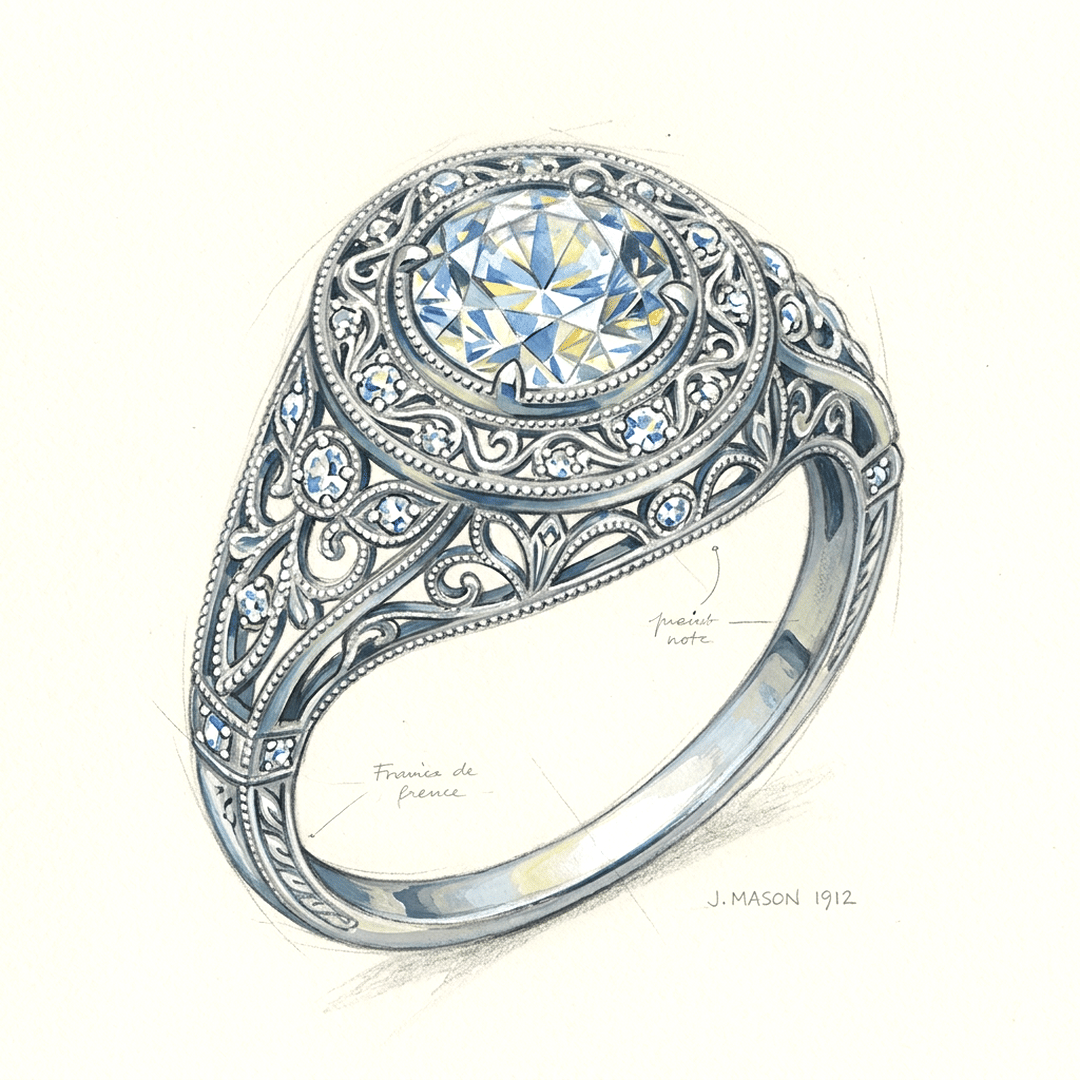
Named for King Edward VII, this era lasted barely nine years, officially ending with his death in 1910, though its lace-like aesthetic lingered until World War I shut down fine jewelry production almost entirely. Because the window was so short and the pieces so delicate, genuine Edwardian rings are today some of the rarest antique jewels on the market. Historically, it's the bridge between Victorian sentimentality and Art Deco boldness, with a delicacy that still feels distinct from anything else on this list.
The invention that made "lace in metal" possible
Here's the detail most guides skip: Edwardian jewelry's signature look (impossibly fine platinum filigree that looks more like embroidery than metalwork) wasn't really a style choice. It was a technology unlock. Platinum melts at nearly 3,200°F, far too hot for jewelers' tools at the time. It took the invention and refinement of the oxy-acetylene torch around the turn of the century to let goldsmiths finally solder platinum with the precision needed for openwork this fine. Suddenly a metal that had been nearly unworkable became the only metal capable of the look everyone wanted.
Cartier, a king, and the birth of "the white era"
In 1904, Louis Cartier was named official jeweler to King Edward VII, who reportedly told him he was "the king of jewelers, the jeweler of kings." Cartier's platinum-and-diamond designs became the template for high society, and the resulting "white on white" palette (platinum, diamonds, no warm gold in sight) was a deliberate departure from the heavier yellow-gold Victorian look. It mirrored a real fashion shift too: women were moving out of stiff corseted silhouettes into flowing, columnar Edwardian gowns, and their jewelry got lighter and airier to match.
Design detail worth knowing
Much of the era's motif language (garlands, bows, laurel wreaths, ribbon swags) was a conscious revival of 18th-century French court style, nicknamed "garland style." Edwardian jewelers were nostalgic for pre-Revolution French elegance the same way today's designers might revive mid-century modern design.
That airy, platinum-forward silhouette is exactly what makes Edwardian engagement rings feel so at home in modern collections: the filigree reads as intricate rather than dated, and the white-on-white palette pairs naturally with today's diamonds.
‹ ›
Art Deco
1920s – 1930sThe only major ring era with a rule against nostalgia.
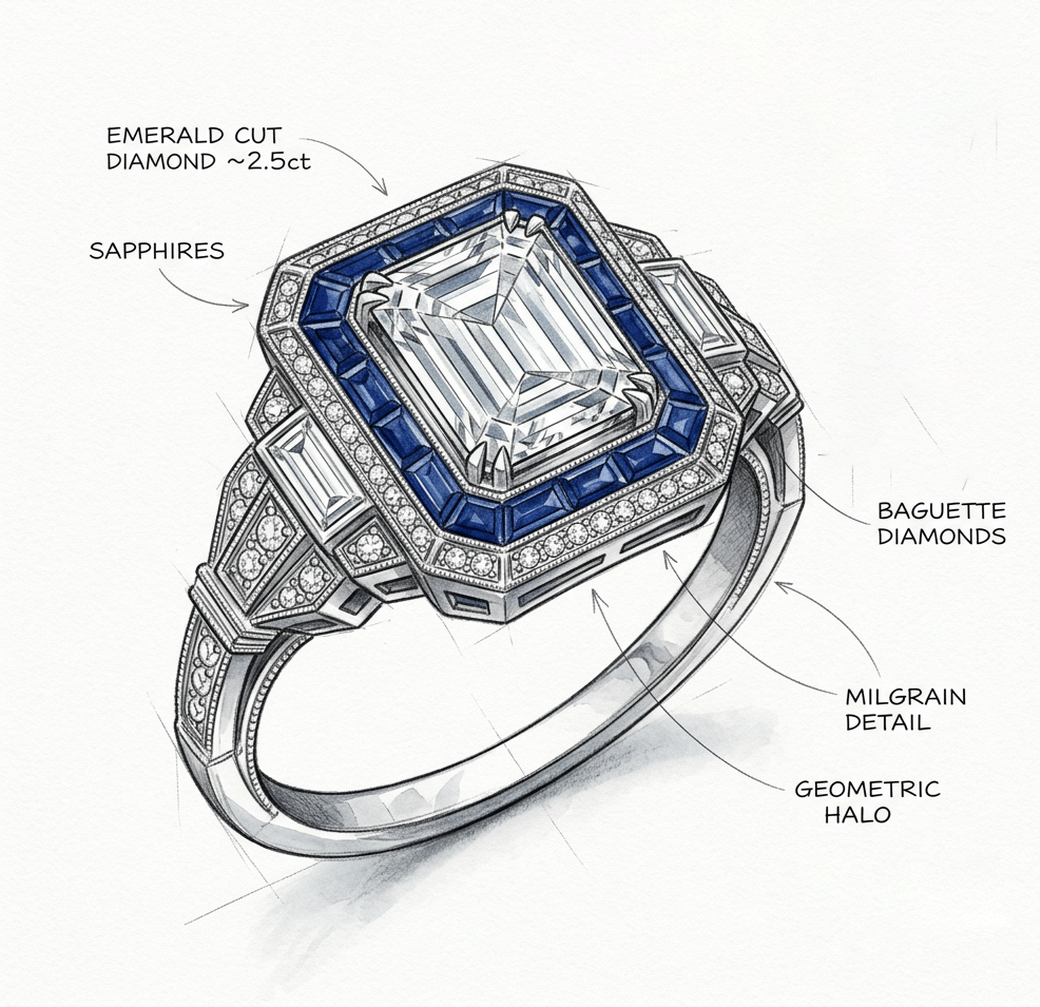
Here's what makes Art Deco genuinely different from every era around it: Victorian, Edwardian, and Retro design all looked backward for inspiration to some degree. Art Deco was the opposite. The style takes its name from the 1925 Exposition Internationale des Arts Décoratifs et Industriels Modernes in Paris, an exhibition whose rules explicitly banned historical reproductions. Designers were required to create something genuinely new. That single rule is arguably why Art Deco still reads as "modern" a century later; it was engineered to never look backward.
A pharaoh's tomb and a jewelry craze
In November 1922, Howard Carter broke through the sealed doorway of Tutankhamun's tomb, and the discovery ignited a wave of "Egyptomania" across Europe and America. Cartier alone produced roughly 150 Egyptian Revival pieces between 1922 and 1925, incorporating scarabs, lotus blossoms, sphinxes, and stepped pyramid silhouettes directly into ring shoulders and settings. It's a rare, documented case of an archaeological discovery reshaping engagement ring design within just a couple of years.
Geometry as rebellion
Art Deco rings traded Victorian curves and Edwardian garlands for hard-edged squares, chevrons, sunbursts, and stepped tiers, a direct echo of Cubism and the new machine age. This wasn't just aesthetic preference. The 1920s were the decade women in the UK and US had just won the right to vote, cut their hair into bobs, and rewrote the rules of how they dressed and behaved in public. A ring built from confident, symmetrical geometry instead of soft, romantic florals was very much in step with that cultural moment. It's also why Art Deco engagement rings still feel so graphic and current: that geometric confidence never really went out of style.
An expert's authentication tip
Genuine Art Deco platinum pieces often carry only an informal "PLAT" or "Pt" stamp rather than a full hallmark: platinum didn't become a legally hallmarked metal in the UK until 1975, decades after these rings were made. And look closely at the tiny beaded edging called milgrain: on an authentic hand-tooled piece, the beading is subtly irregular. Perfectly uniform milgrain usually means a modern machine-made reproduction, not a period-correct original.
What to look for
- Cut: Emerald cut (peak popularity from 1925), Asscher cut (patented in 1902, but it took Art Deco to make it iconic), and calibré-cut baguettes engineered to fit precisely, like puzzle pieces, around a center stone
- Metal: Platinum, prized because its strength let jewelers use minimal metal for maximum intricacy; white gold as a more affordable alternative
- Color: Deliberate contrast: onyx, sapphire, emerald, and ruby set alongside diamonds, composed almost like a small painting rather than a single-stone showcase
- Houses to know: Cartier, Van Cleef & Arpels, Boucheron, and Mauboussin were the era's defining ateliers
‹ ›
Retro
1935 – 1950sJewelry got bigger exactly when the world had less.
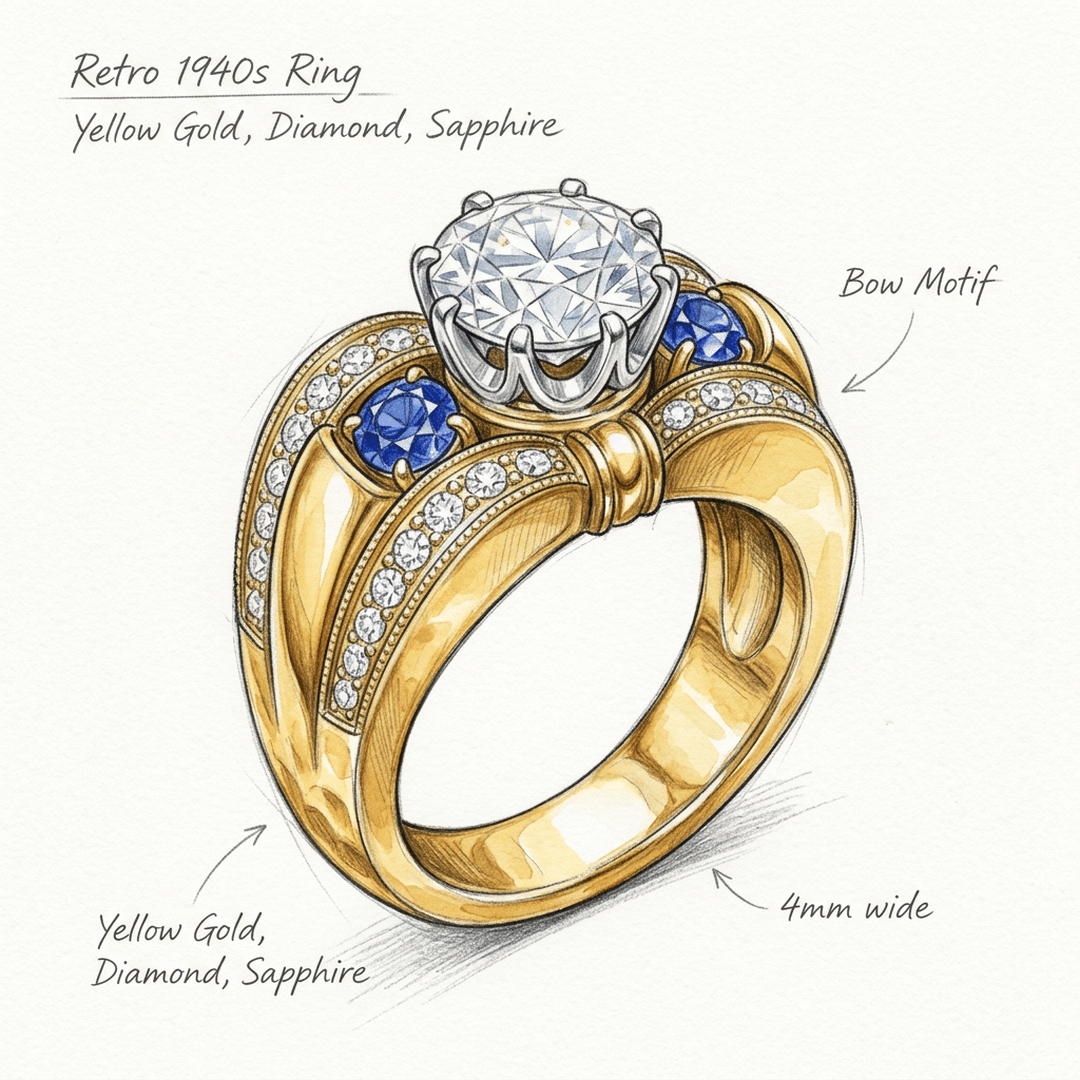
Retro is the era people most often mislabel: "retro" and "vintage" get used interchangeably in casual conversation, but as a design period, Retro specifically means the bold, oversized jewelry of the mid-20th century, roughly 1935 into the early 1950s. And it exists almost entirely because of what was happening far outside the jewelry workshop.
A war that made platinum illegal to buy
During World War II, platinum was officially classified a strategic war metal in the US, essential for military and industrial use, and its sale for civilian jewelry was restricted. Gold was also tightly rationed. Jewelers responded with real ingenuity: they stretched limited gold supplies by alloying it more heavily with copper, which produces a warm, rosy tone, and rose gold, largely a wartime workaround, became one of the defining looks of the decade rather than a niche choice.
Bigger, brighter, and unapologetically bold
With diamonds hard to source and platinum off the table, designers leaned into large citrines, aquamarines, topaz, and amethysts, plus the era's synthetic rubies and sapphires, set in sweeping, sculptural rose and yellow gold. Motifs borrowed straight from wartime life (tank-tread link bracelets, patriotic flags and eagles, "V for Victory" symbols) sat right alongside glamorous bow and ribbon designs influenced by Hollywood's golden age. There's something quietly moving about it: at the exact moment rationing made daily life smaller, jewelry design got dramatically, deliberately bigger. A statement ring wasn't excess. It was a small act of optimism.
The fact that changes how you see every ring after this one
The "diamond engagement ring" you probably think of as an ancient, unbreakable tradition is largely a Retro-era invention. After WWII, with the diamond trade recovering, De Beers and its advertising agency launched the "A Diamond Is Forever" campaign in 1947, deliberately building diamonds into the cultural expectation for an engagement ring. Every era before this one in this article proves rings were plenty meaningful without a diamond being mandatory. The idea that they're required is, historically speaking, barely 80 years old.
That same bold, optimistic spirit is what draws people to Retro engagement rings today: sculptural gold, warm tones, and a scale that isn't afraid to be noticed.
‹ ›
Quick-ID Cheat Sheet
Hold this up next to any vintage engagement ring and you can date it in about ten seconds.
| Era | Years | Signature Cut | Metal | Instant Tell |
|---|---|---|---|---|
| Victorian | 1837–1901 | Old Mine Cut | Yellow gold | Serpents, hearts, flowers & hidden-word gem messages |
| Edwardian | 1901–1910 | Old European, Rose | Platinum | Lace-thin filigree; garlands, bows & laurel wreaths |
| Art Deco | 1920s–1930s | Emerald, Asscher | Platinum | Hard geometric lines; onyx & color used for contrast |
| Retro | 1935–1950s | Round, Baguette | Rose & yellow gold | Big, sculptural scale; bold color; tank-tread links |
Which Era Speaks to Your Story?
You don't have to choose based on history alone: choose the era whose values feel like yours. Victorian-inspired, if your love runs sentimental and symbolic. Edwardian-inspired, for lace-fine platinum romance. Art Deco-inspired, if you want bold, architectural confidence with a century of staying power already proven. Retro-inspired, for scale and warmth with a little Hollywood glamour.
Frequently Asked Questions
What's the difference between "vintage" and "antique" when it comes to engagement rings?
“Antique” generally refers to a piece that is 100 years old or older. “Vintage” is a looser term, usually covering roughly 20 to 99 years old, or simply a ring made in the recognizable style of an earlier decade. The four eras covered in this guide span both categories: Victorian and Edwardian originals would now qualify as antique, while Retro pieces from the 1940s sit right at the edge of “vintage.”
What does "vintage-inspired" mean, and is that the same as buying an antique ring?
A vintage-inspired ring is newly made, using modern manufacturing and materials, but designed to echo the motifs, cuts, and proportions of a historical era. It is not the same as buying an actual antique: an antique ring is a period-original piece, with all the rarity, wear, and condition variability that implies. Vintage-inspired rings let someone wear that era's look with the consistency and craftsmanship of a new piece. You can browse our full vintage-inspired engagement ring collection to see the range firsthand.
How can I tell what era an engagement ring's design comes from?
The fastest way is to look at three things together: the cut, the metal, and the motifs. An Old Mine Cut in yellow gold with serpent or floral details points to Victorian. Fine platinum filigree with garlands and bows points to Edwardian. Hard geometric lines in platinum, often with onyx or colored stone contrast, point to Art Deco. Large, sculptural pieces in rose or yellow gold point to Retro. The Quick-ID Cheat Sheet above lays these out side by side for exactly this reason.
Which metal is associated with each engagement ring era?
Victorian rings were predominantly yellow gold. Edwardian and Art Deco rings both favor platinum, though for different reasons: Edwardian jewelers gained the ability to work platinum thanks to the invention of the oxy-acetylene torch, and Art Deco designers prized it for its strength. Retro rings shifted back to rose and yellow gold, largely because platinum was restricted for civilian use during World War II.
Why did platinum disappear from engagement rings after Art Deco?
Platinum was officially classified a strategic war metal in the United States during World War II, and its sale for civilian jewelry was restricted. Jewelers responded by alloying gold more heavily with copper for a warm, rosy tone, which is why Retro-era rings are so strongly associated with rose gold rather than platinum.
Do vintage-style engagement rings have to have a diamond as the center stone?
No. Diamonds only became the default expectation for an engagement ring after De Beers' “A Diamond Is Forever” campaign launched in 1947, which is itself a Retro-era development. Victorian rings often used colored gemstones to spell out sentimental messages, and Art Deco rings deliberately combined onyx, sapphire, emerald, and ruby alongside, or instead of, diamonds.
Which vintage engagement ring era is most popular right now?
Taste is genuinely personal here, and all four eras remain in steady demand for different reasons. That said, Art Deco and Retro styles have seen strong renewed interest in recent years for their bold, graphic look, while Victorian and Edwardian styles continue to appeal to those drawn to more delicate, sentimental designs.
How do I decide which era's style is right for me?
Choose based on which values feel like yours rather than history alone. Victorian-inspired suits a sentimental, symbolic love story. Edwardian-inspired suits someone drawn to lace-fine platinum romance. Art Deco-inspired suits bold, architectural confidence. Retro-inspired suits scale, warmth, and a bit of Hollywood glamour.