Good to Have You Back

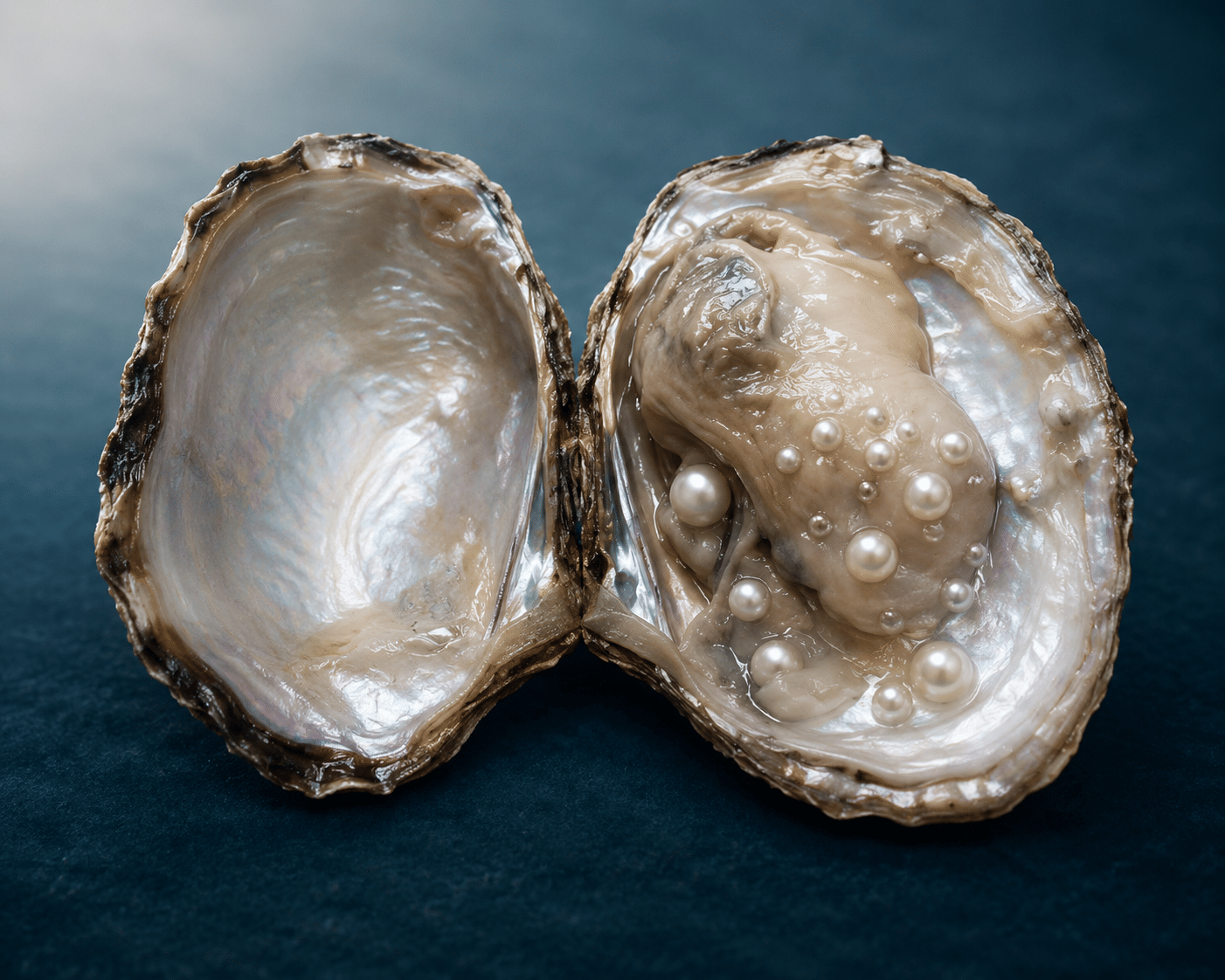
A pearl begins as a threat. Something foreign slips inside a living mollusk, a creature that cannot simply brush it away, and so it does the only thing it can: it wraps it. Layer by microscopic layer, month by month, the mollusk covers that irritant in a luminous mineral coating until something remarkable takes shape inside its shell.
That process is pearl formation, and it is one of the most extraordinary things that happens in the natural world. Unlike every other gemstone on earth, no heat, no pressure, and no mining equipment is involved. A pearl is grown, not extracted, by a living animal following instincts millions of years in the making.
This guide covers the complete science of how pearls form: what nacre is, why the "grain of sand" story is mostly a myth, how cultured pearls differ from natural ones, what formation reveals about luster and value. By the end, you will understand pearl jewelry differently, and you will see it differently, too.
First: The grain of sand story is mostly wrong
Almost every childhood explanation of pearl formation goes like this: a grain of sand gets inside an oyster, the oyster gets irritated, and a pearl grows around it. It is a satisfying story, but it is mostly inaccurate. Oysters are actually very efficient at expelling sand, ejecting grains before any nacre deposition begins.
What actually triggers pearl formation in the wild is usually a parasite that burrows into the mollusk's soft tissue and cannot be removed, or occasionally a displaced fragment of the mollusk's own tissue. Either way, the trigger is biological, not debris from the ocean floor.
What happens to the irritant over time?
The original irritant stays at the center of the pearl permanently, but by the time a natural pearl is fully formed, the organic matter at the core has typically decomposed, leaving a microscopic void rather than an intact organism. This is one reason gemologists can tell natural pearls from cultured ones under X-ray: a natural pearl shows an irregular core, while a cultured pearl shows a clean, round shell nucleus.
Why this matters for value
The trigger material affects the pearl's shape. A round bead nucleus (used in cultured pearls) produces rounder pearls. An organic parasite or tissue fragment produces the irregular shapes common in natural pearls, including the baroque forms prized by collectors.
How are pearls formed in oysters: The science, step by step
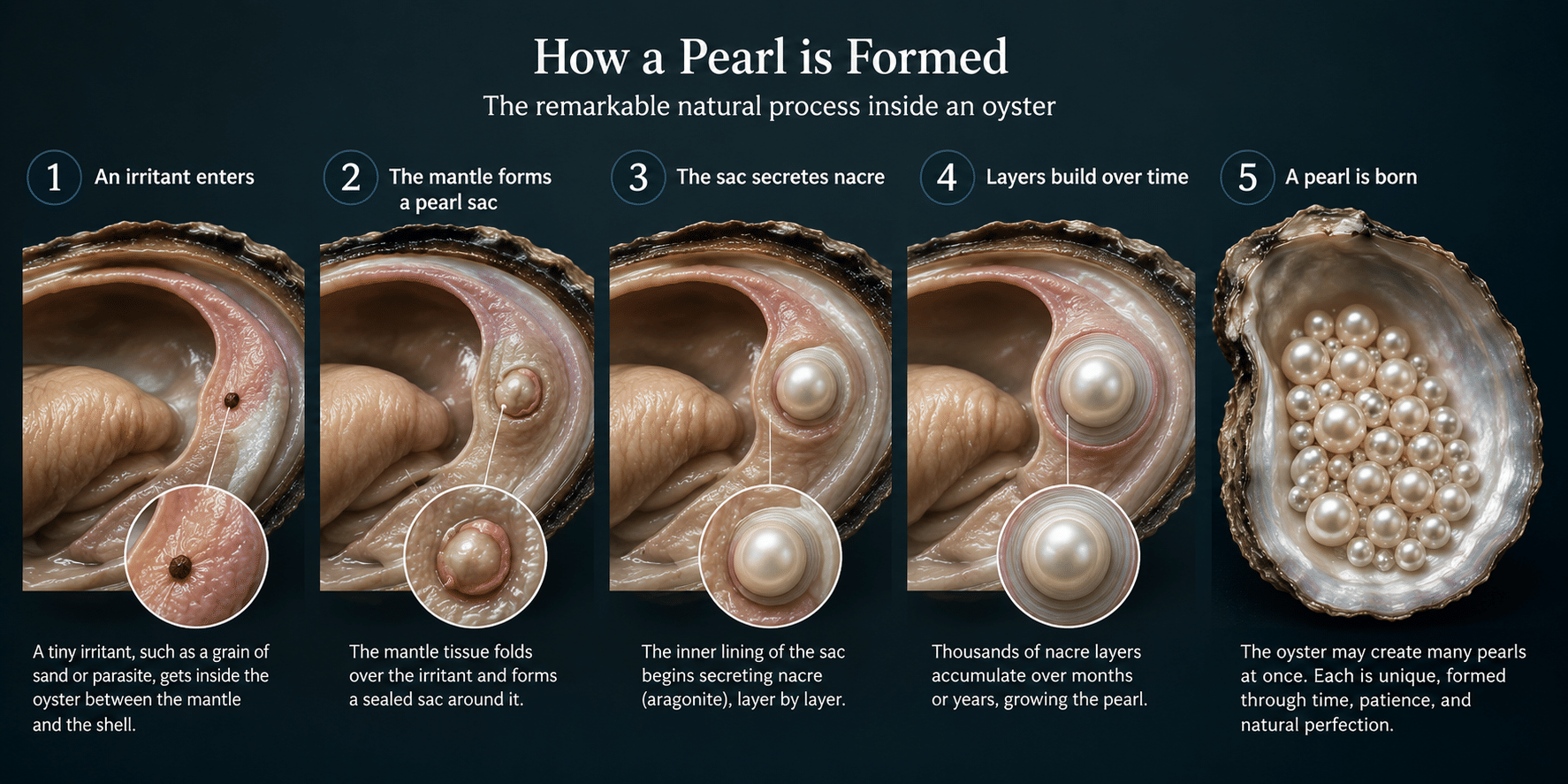
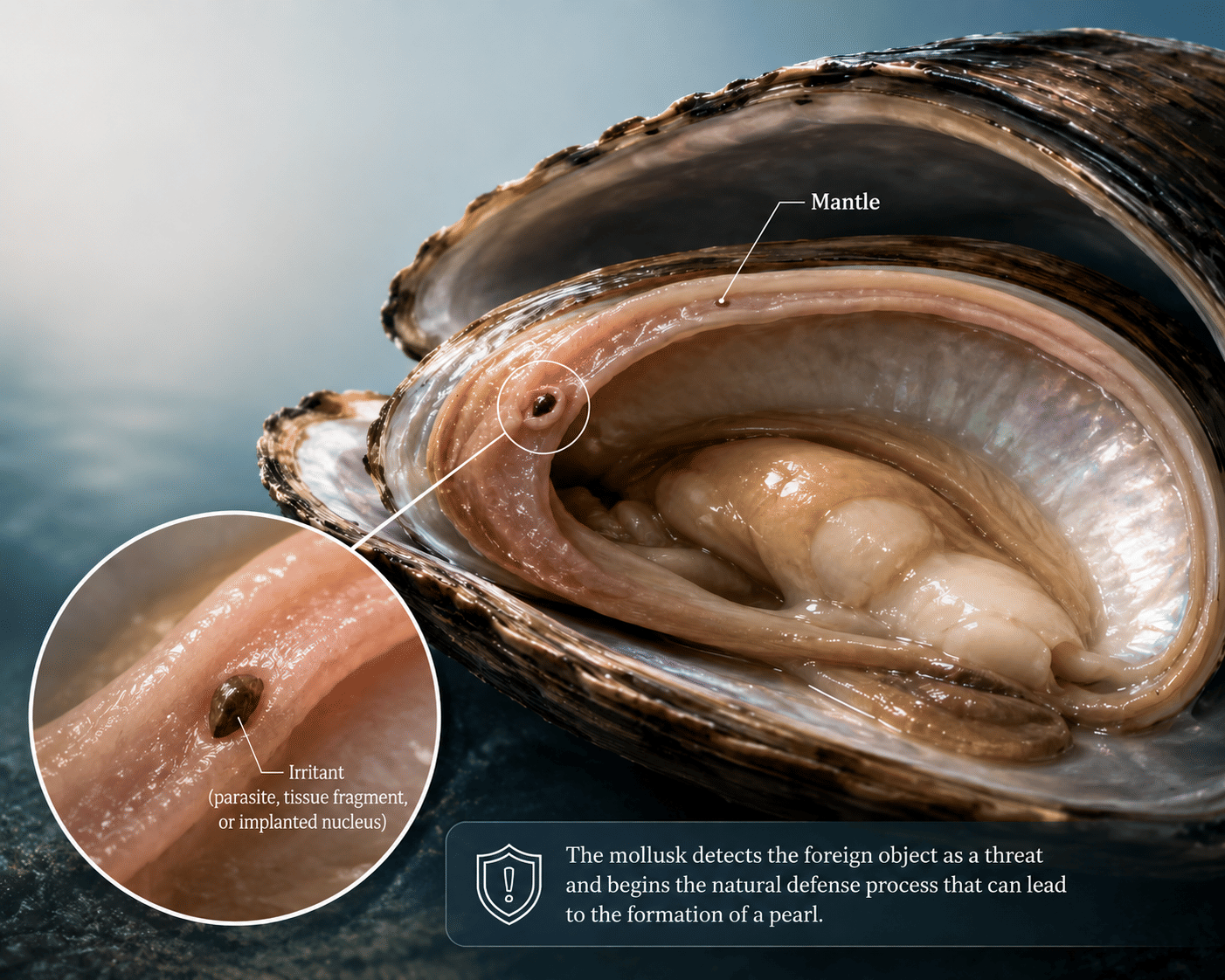
Step 1: The irritant lodges in the mantle
The mantle is the thin fold of tissue that lines the inside of a mollusk's shell. It is the organ responsible for shell growth, and it is highly sensitive. When a parasite, tissue fragment, or (in cultured pearls) an implanted nucleus becomes lodged in the mantle, the mollusk immediately registers it as a foreign body.
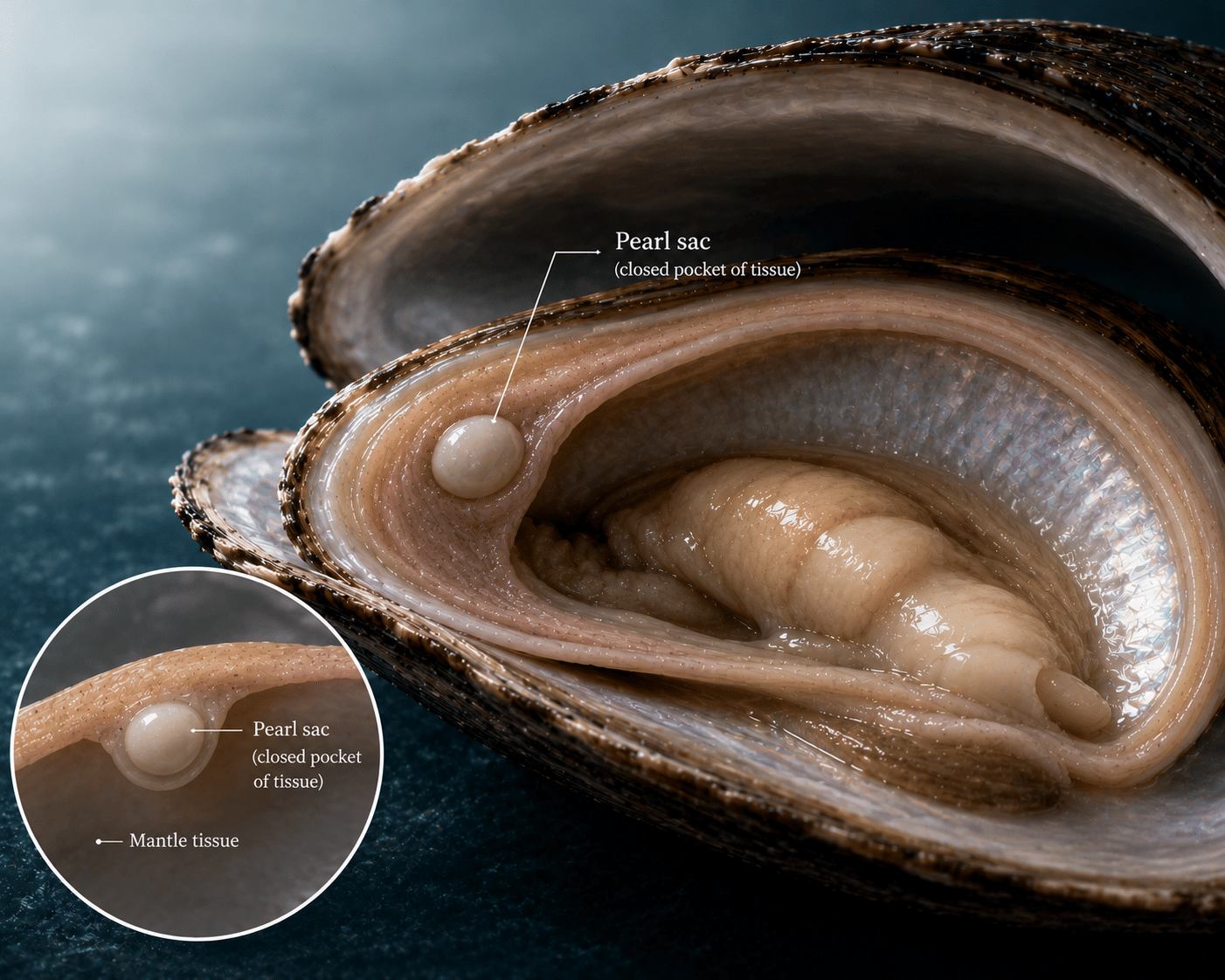
Step 2: A pearl sac forms
The mollusk's mantle cells surround the irritant and form what is called a pearl sac, a closed pocket of epithelial tissue that walls off the intruder. This sac is where everything happens. The cells lining the interior of this sac are the same cells responsible for secreting the mollusk's shell, which means they are already perfectly equipped for what comes next.
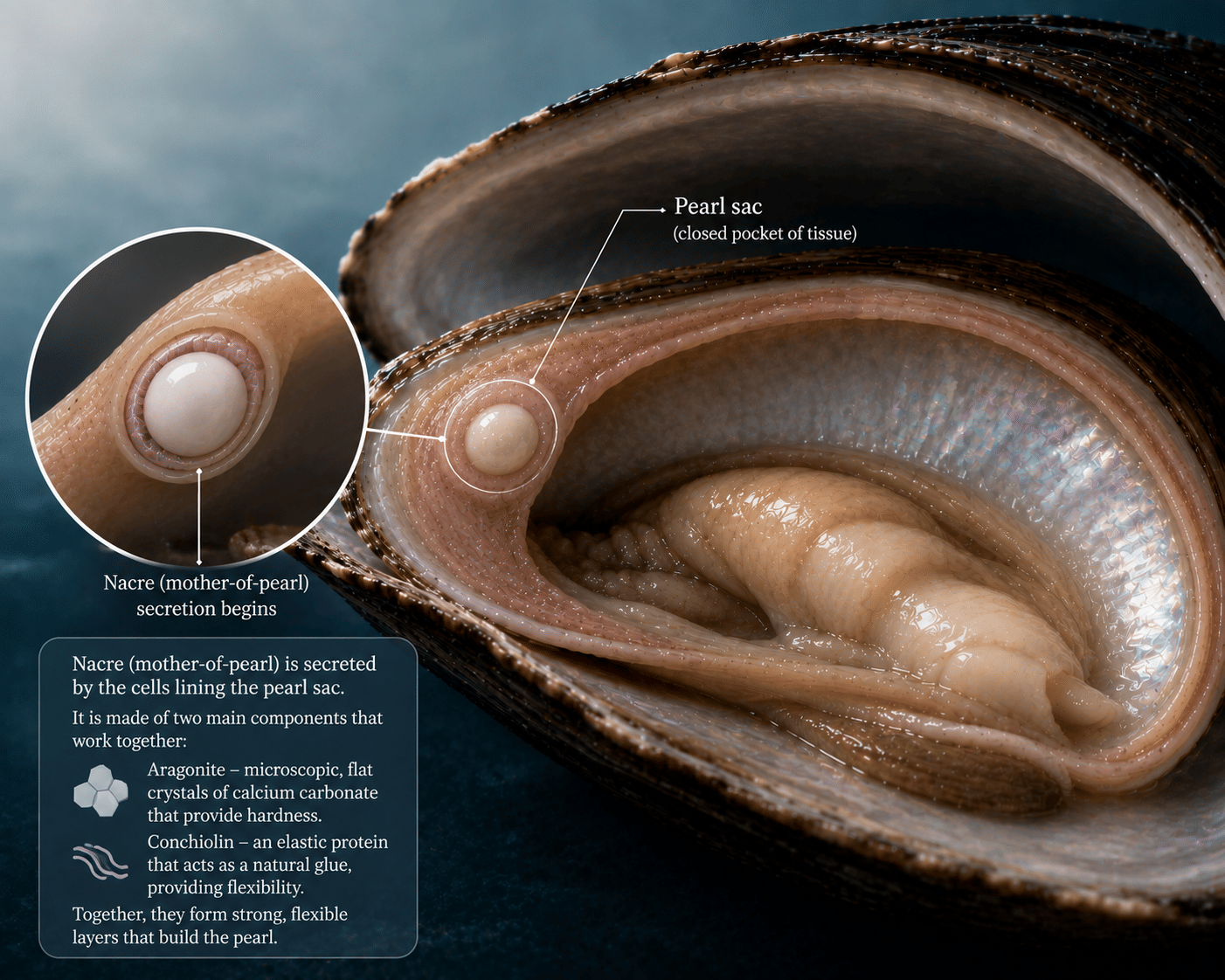
Step 3: Nacre secretion begins
The pearl sac begins secreting nacre (pronounced NAY-kur), also known as mother-of-pearl. Nacre is a composite biomaterial made of two primary components:
- Aragonite: a crystalline form of calcium carbonate that forms flat, hexagonal platelets
- Conchiolin: an elastic protein that acts as a biological glue, binding the aragonite layers together and allowing the structure to flex without fracturing
These two materials work together the way bricks and mortar work together: the aragonite provides hardness, and the conchiolin provides flexibility. The result is a material stronger than most ceramics and significantly tougher than glass.
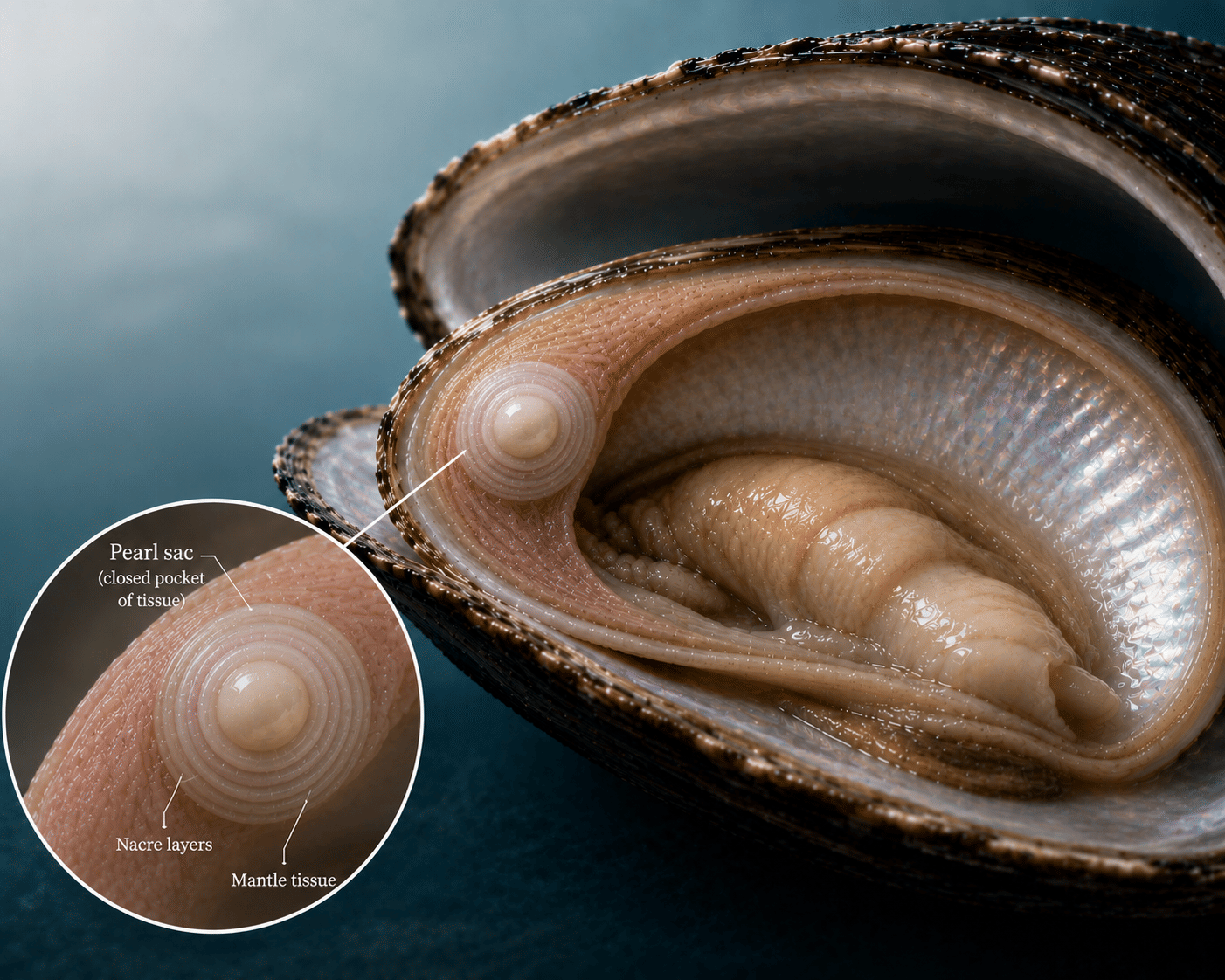
Step 4: The layers build
Nacre is deposited in extremely thin sheets, laid down concentrically one on top of the other over months to years. Hundreds to thousands of these layers accumulate, and it is this stacking of semi-transparent mineral sheets that produces the pearl's signature luster. Light penetrates the surface, reflects off inner layers, and returns as the glow-from-within effect that distinguishes a fine pearl from any other gemstone.
Step 5: The pearl matures
Pearl growth continues for as long as the mollusk remains healthy and the pearl sac remains active. The total growth period depends heavily on the species, the water temperature, and environmental conditions. A general timeline:
| Pearl type | Host mollusk | Formation time | Nacre thickness |
| Akoya (cultured) | Pinctada fucata | 10 to 18 months | 0.35 to 0.7 mm |
| Freshwater (cultured) | Hyriopsis cumingi | 2 to 5 years | 0.5 to 6 mm (all nacre) |
| South Sea (cultured) | Pinctada maxima | 2 to 4 years | 2 to 6 mm |
| Tahitian (cultured) | Pinctada margaritifera | 18 months to 3 years | 0.8 to 4 mm |
| Natural pearl | Various wild mollusks | 5 to 20+ years | Varies widely |
Natural vs. cultured pearls: Same process, different starting points
This is one of the most misunderstood distinctions in fine jewelry, and it is worth being direct about it: cultured pearls are real pearls. They are not imitations, not fakes, and not lesser gems. The biological process that creates them is identical to the one that creates natural pearls. The only difference is in how that process begins.
Natural pearls
A natural pearl forms entirely by accident, with no human involvement. A wild mollusk encounters a parasite or tissue fragment, its mantle cells form a pearl sac, and nacre deposition begins. Because this happens randomly in an open marine environment, natural pearls are extraordinarily rare. Before widespread pearl farming, finding a natural pearl required opening thousands of oysters. Most of those oysters yielded nothing.
Cultured pearls
Cultured pearls were developed in the late 19th and early 20th century, primarily in Japan. The process involves a skilled technician called a grafter performing a precise surgical procedure on the mollusk:
- A small, round bead nucleus is prepared, typically made from the polished shell of a freshwater mussel
- The grafter carefully opens the mollusk and inserts the nucleus into the gonad (for saltwater pearls) or mantle tissue (for freshwater pearls)
- A small piece of mantle tissue from a donor oyster is placed alongside the nucleus to initiate pearl sac formation
- The mollusk is returned to the water to heal and begin nacre secretion
After this point, nature takes over entirely. The mollusk coats the nucleus in nacre at its own pace, producing overtones and luster that are determined by its own genetics and environment, not by human direction. The result is chemically and structurally identical to a natural pearl.
The key difference at a glance
In a natural pearl, the entire pearl is nacre. In a bead-nucleated cultured saltwater pearl, the nacre layer wraps around a shell bead core. In cultured freshwater pearls, which use tissue rather than a bead, the pearl is typically all-nacre or nearly so, making them structurally more similar to natural pearls than Akoya or South Sea types.
What formation tells you about quality and value
Understanding how pearls form makes identifying imitations straightforward, because genuine nacre has physical properties that no surface coating can replicate. Here are some tests you can try:
Formation is the foundation of everything that makes a pearl worth what it is. If you want to go deeper on pricing, grading, and what different pearl types actually sell for, read our guide on how much pearls are worth.
Luster
Luster is the most important quality factor in a pearl, and it is entirely a product of nacre. When layers are numerous and well-aligned, light penetrates the surface, reflects off multiple layers simultaneously, and returns as the sharp, mirror-like glow that defines a fine pearl. Uneven or sparse growth produces a cloudier, chalky surface. Strong luster is your best proxy for nacre quality, and it also signals greater durability.
Shape
Shape comes down to how evenly the pearl sac deposits nacre around the nucleus. Perfectly even deposition produces a round pearl; uneven growth produces drops, buttons, ovals, or baroque shapes. Round is the rarest outcome, which is why it commands the highest prices.
Color and Overtone
A pearl's color is not added after formation. It is grown in. Body color is determined by the species of mollusk, and overtone by the way nacre layers diffract light. Neither can be replicated by surface treatment. Any pearl described as dyed should be priced accordingly.
How pearls are formed by pearl type
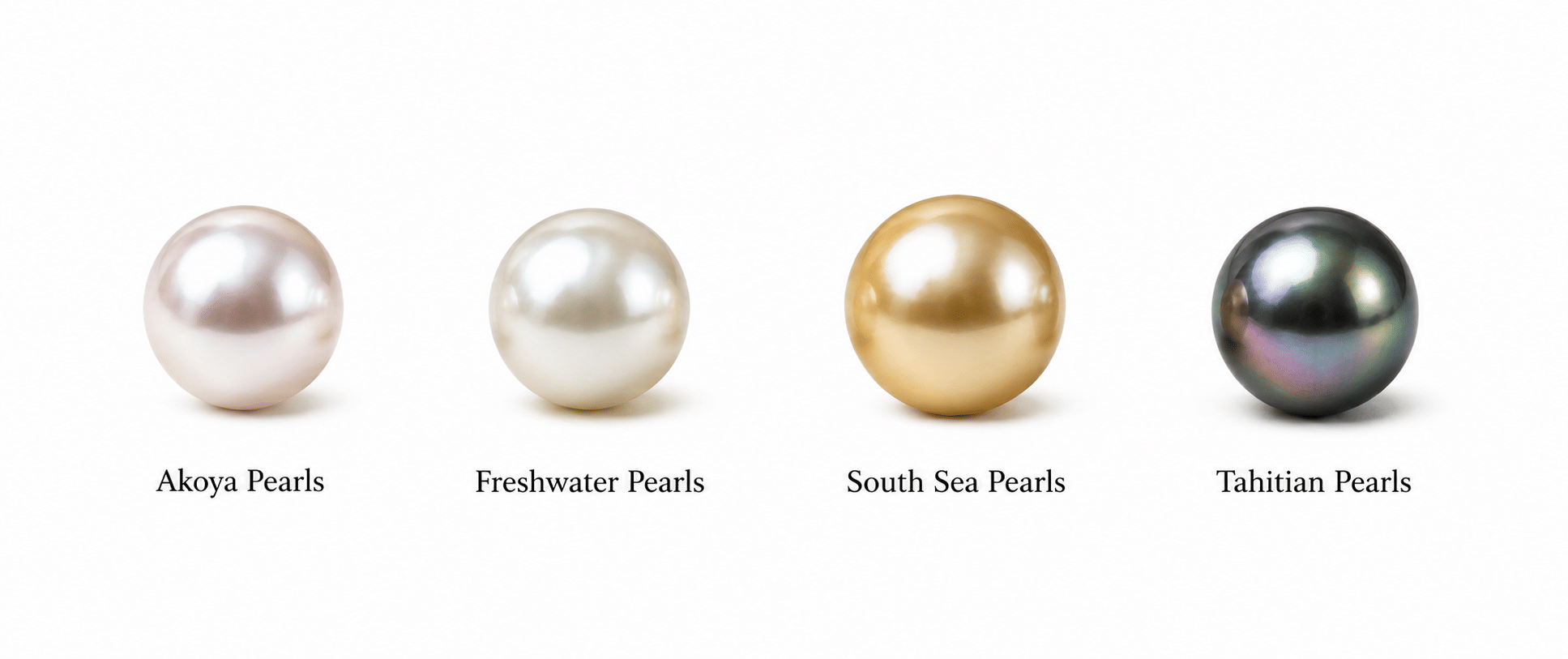
Akoya pearls
Host: Pinctada fucata martensii (Japan, China)
Nucleated with a round bead and donor tissue, then grown in cooler saltwater bays. The cold water slows nacre secretion, producing tightly stacked layers and the sharp, bright luster Akoya pearls are known for. Nacre tends to be thinner than other types, so quality grading matters more here.
Freshwater pearls
Host: Hyriopsis cumingi (China, primarily)
Nucleated with tissue only, no bead, so the pearl is almost entirely nacre from edge to center. One mussel can carry 20 to 50 pearls at once, making freshwater the most accessible type. Pearls are also June's birthstone, making freshwater pearl jewelry a natural gift for anyone born that month. Learn more in our guide “What is June's birthstone.”
South Sea pearls
Host: Pinctada maxima (Australia, Indonesia, Philippines)
The largest cultured pearls are typically 10 to 18mm. Warm tropical waters accelerate nacre secretion, producing thick nacre and a satiny luster quite different from Akoya. Size, nacre depth, and rarity put these among the most valuable pearls in the world.
Tahitian pearls
Host: Pinctada margaritifera (French Polynesia)
The only commercially produced pearls in naturally dark tones. Color comes from the black-lipped oyster's biology, not treatment, ranging from charcoal to deep green with peacock and silver overtones. Highly sensitive to environmental conditions, so quality varies significantly harvest to harvest.
Real pearl vs fake pearl: How to spot an imitation pearl
Understanding how pearls form makes identifying imitations straightforward, because genuine nacre has physical properties that no surface coating can replicate. Here are some test you can try:
The tooth test
Gently rub the pearl along the edge of your front teeth. Real pearls, whether natural or cultured, feel slightly gritty or sandy. This texture comes from the microscopic ridges between nacre platelets. Imitation pearls, which are typically glass or plastic beads coated in a pearlescent lacquer, feel perfectly smooth.
The luster test
Hold the pearl under a light source and look at the reflection. Genuine nacre produces a reflection with depth, a brightness that appears to come from beneath the surface. Imitation pearls produce a surface-only shine, similar to the sheen on a painted object, with no sense of internal glow.
The weight test
Real pearls are denser than most imitations. Glass imitations tend to feel heavier than genuine pearls; plastic imitations feel notably lighter. This is a rough guide rather than a definitive test, but it is useful in combination with the others.
How to style pearl jewelry
Once you understand what goes into growing a pearl, it is easier to appreciate how versatile they are to wear. Pearls move easily between warm and cool metals, which makes building a look simple, whether your style leans classic or contemporary.
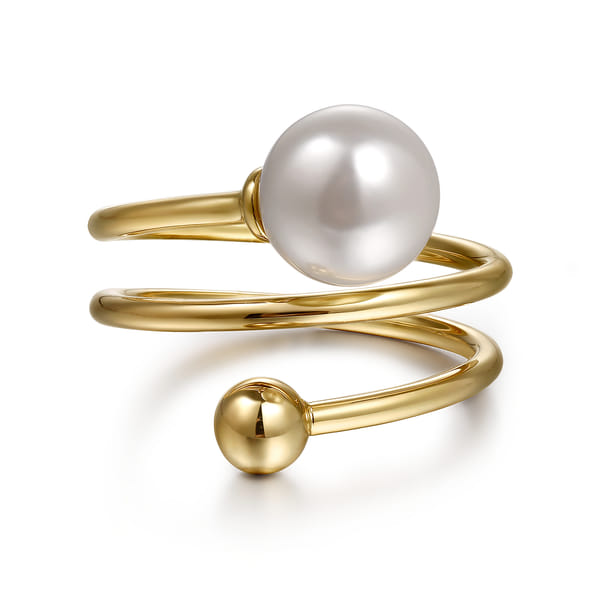
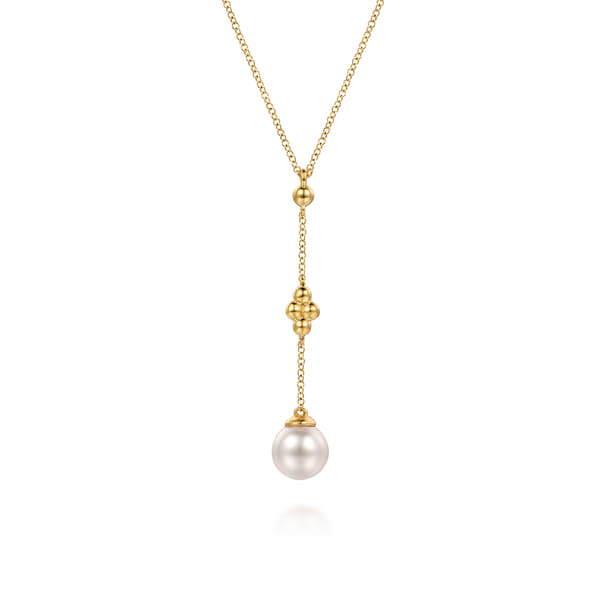
Yellow gold pearl edit
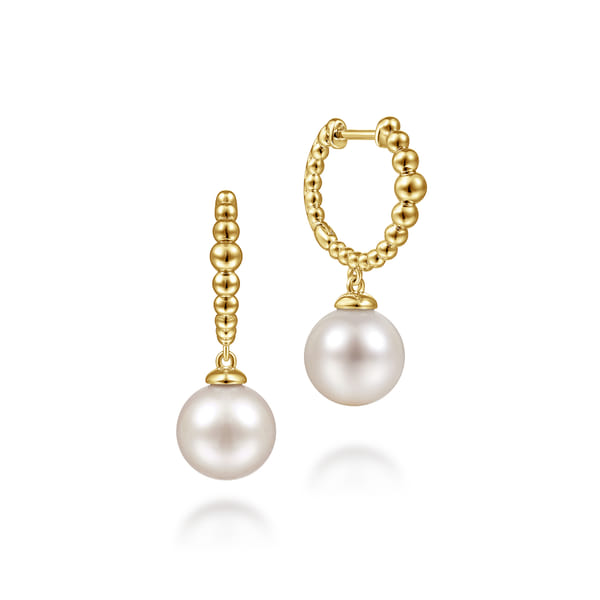
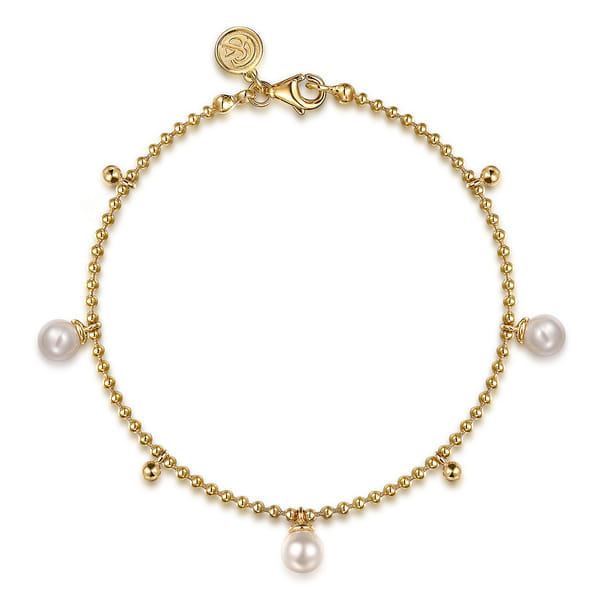
Yellow gold brings out the warmth in cream and white pearls, making this pairing feel rich and a little vintage-inspired. It works especially well for evening looks or layered styling: try the necklace and bracelet together for a stacked, beaded effect, then let the ring and earrings stand alone for daytime wear.
Sterling silver pearl edit
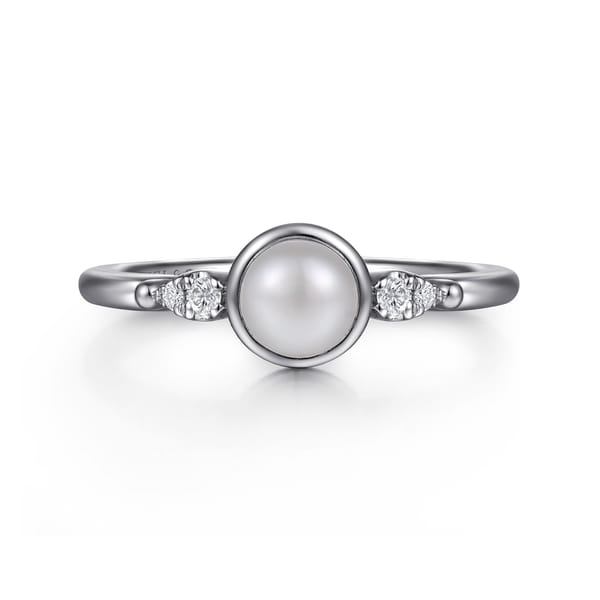
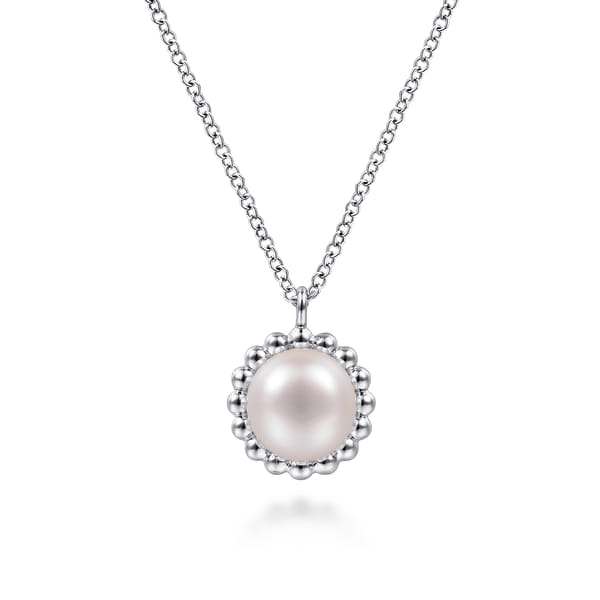
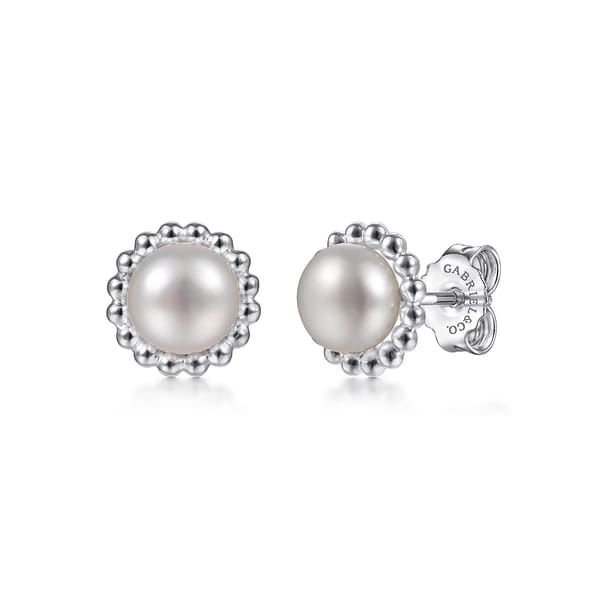
Silver gives pearls a cooler, more modern edge, which makes this pairing especially versatile for everyday wear. The Bujukan beaded texture echoes the natural, layered structure of nacre itself, so these pieces read as intentional rather than simply matching. Wear the stud earrings and pendant together for a clean, understated look, or add the ring and bracelet for more dimension.
The takeaway
A pearl is the only gemstone that begins as a defense mechanism, a living creature's response to a tiny irritant, unfolding layer by layer over months or years. That process determines everything about the finished gem: its luster, shape, color, and rarity.
Pearl jewelry at Gabriel & Co. is selected with attention to nacre quality, luster, and sustainable sourcing. That same quality and grace is part of why pearls have long been a symbol of purity and new beginnings, a fitting choice for brides. Explore our bridal jewelry collection to find pieces as enduring as the moment they are made for.
FAQs
How long does it take for a pearl to form?
Cultured Akoya pearls take 10 to 18 months. Cultured South Sea and Tahitian pearls take 18 months to 4 years. Freshwater cultured pearls take 2 to 5 years. Natural pearls, which form without human assistance, can take 5 to 20 years or more, which is a primary reason they are so rare.
Do pearls really form from a grain of sand?
Rarely. Oysters are very efficient at expelling sand, and most natural pearls form around a biological irritant such as a parasite, or occasionally a displaced fragment of the mollusk's own tissue. In cultured pearls, the irritant is a bead nucleus placed by a skilled technician.
What is nacre, and why does it matter?
Nacre is the material that pearls are made of. It is composed of aragonite (a crystalline form of calcium carbonate) bound together by a protein called conchiolin. The microscopic layering of nacre platelets creates the pearl's luster, color, and resilience. Thicker nacre generally means better luster, richer color, and greater durability.
Are cultured pearls real pearls?
Yes. Cultured pearls are produced by the same biological nacre-secretion process as natural pearls. The difference is that a human introduces the initial irritant rather than nature doing it by accident. After nucleation, the mollusk grows the pearl entirely on its own. Cultured pearls make up over 99% of pearls sold today.
What makes some pearls more valuable than others?
Value is driven primarily by luster (the depth and brightness of the nacre), followed by surface quality, shape (round being rarest), size, and color. All of these qualities are products of the formation process. A pearl with exceptional luster has thick, well-ordered nacre. A perfectly round pearl formed around an evenly coated nucleus. These qualities cannot be faked by surface treatment and are a direct reflection of how the pearl was grown.
Can pearls form in any oyster or mollusk?
Technically, any bivalve mollusk can produce some form of pearl, but not all mollusks produce nacreous pearls. The lustrous pearls used in fine jewelry come from specific pearl oyster species within the Pinctada genus for saltwater pearls, and Hyriopsis species for freshwater pearls. Non-nacreous pearls, such as conch pearls and melo pearls, are produced by gastropods and have a very different appearance and composition.
How does formation affect the color of a pearl?
Pearl color is determined by two factors that emerge from formation: body color, which comes from pigments in the mollusk's mantle tissue and the specific species involved, and overtone, which is produced by the way nacre layers diffract light. Neither is added after the pearl is harvested. A Tahitian pearl's dark color comes from the black-lipped oyster's biology; a golden South Sea pearl's warmth comes from the gold-lipped oyster's pigmentation.