Good to Have You Back

Bangle bracelets are one of jewelry's oldest and most enduring forms, worn across cultures for over 5,000 years and just as relevant today as ever. In 2026, with wrist stacking at the center of fine jewelry culture, knowing how to choose, size, and style bangles has never mattered more.
This guide covers everything: what bangles actually are, the different types, how to size them, how to stack like a stylist, and how to dress them for any occasion.
What is a bangle bracelet?
A bangle is a rigid bracelet with no clasp, hinge, or flexible links. Unlike chain bracelets or tennis bracelets, it holds its shape completely and sits on the wrist through structure alone. Bangles come in closed styles, which form a full circle, and open styles, sometimes called cuff bangles, which have a gap in the band for easier wear. What unites them is that rigidity: structured metal with no fastener and no adjustment, just a clean, confident fit on the wrist.
The word 'bangle' derives from the Hindi 'bangri,' a glass ornament worn around the wrist, reflecting the deep cultural roots of this form in South Asia, where bangles have been worn for over 5,000 years as symbols of prosperity, protection, and rites of passage. Today, that heritage lives on in a thoroughly modern form, equally at home on the wrist of someone headed to a board meeting, a beach, or a wedding.
The different types of bangles
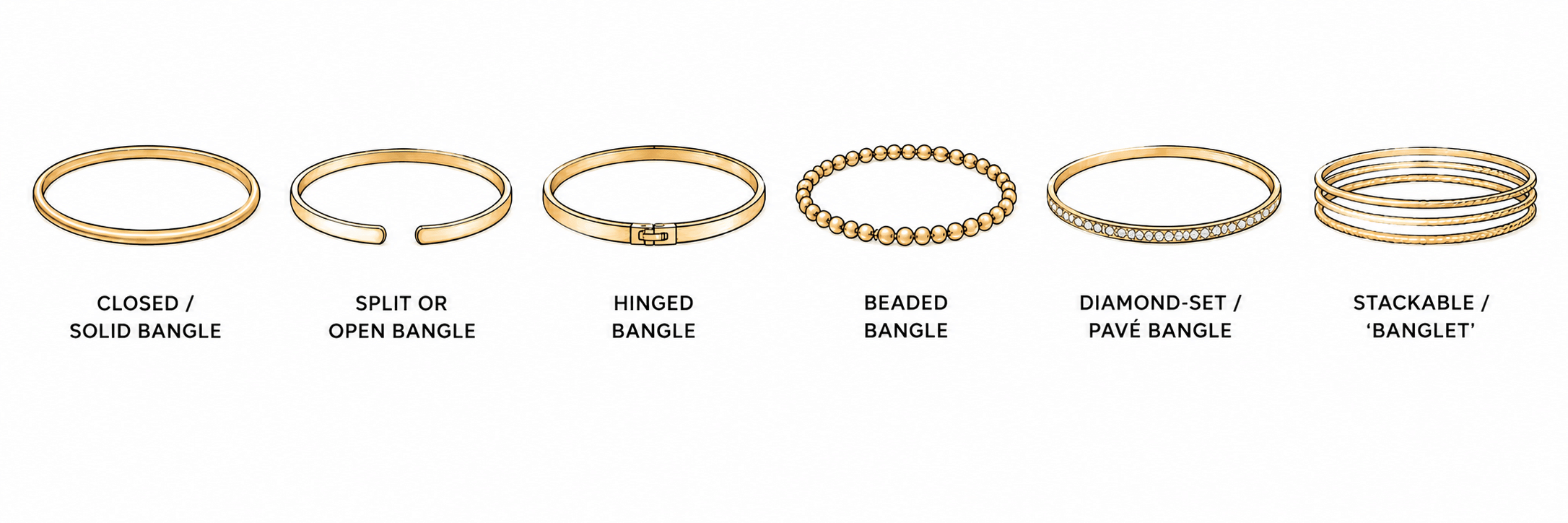
The bangle category is broader than most people realize. Here are the key types worth knowing:
- Closed / solid bangle: A seamless loop with no opening. The purest form. Clean silhouette, perfect foundation for stacking.
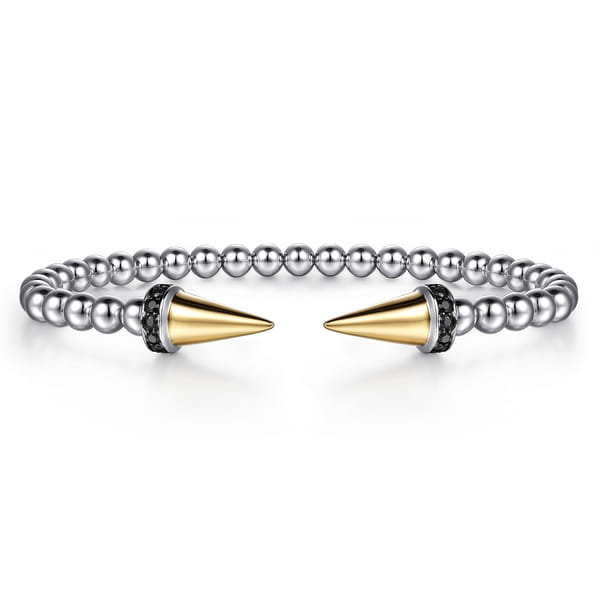
- Split or open bangle: Ends just before completing the circle, leaving a small gap. Does not need to pass over the hand, so sizing is more forgiving. Very stackable.
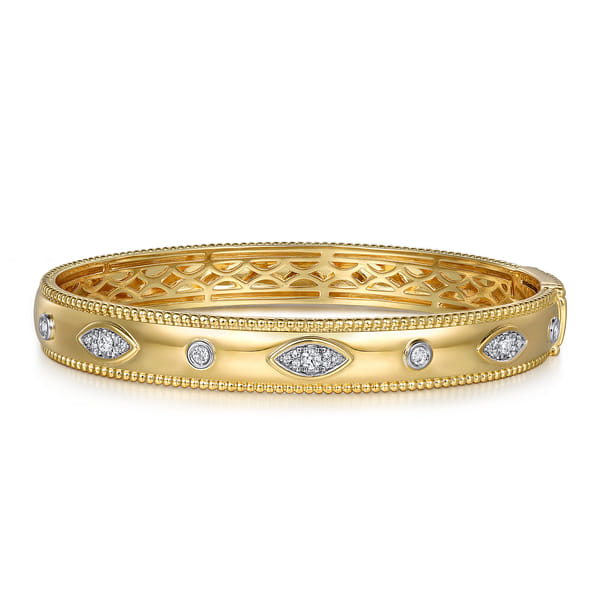
- Hinged bangle: Looks closed but opens via a hinge, making it easier to put on. Often found in wider or heavier statement styles.
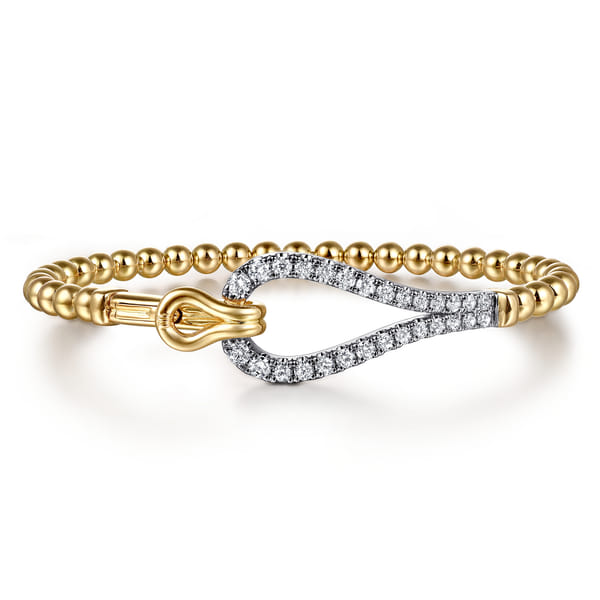
- Beaded bangle: Constructed from rows of small gold or metal spheres rather than a flat band.
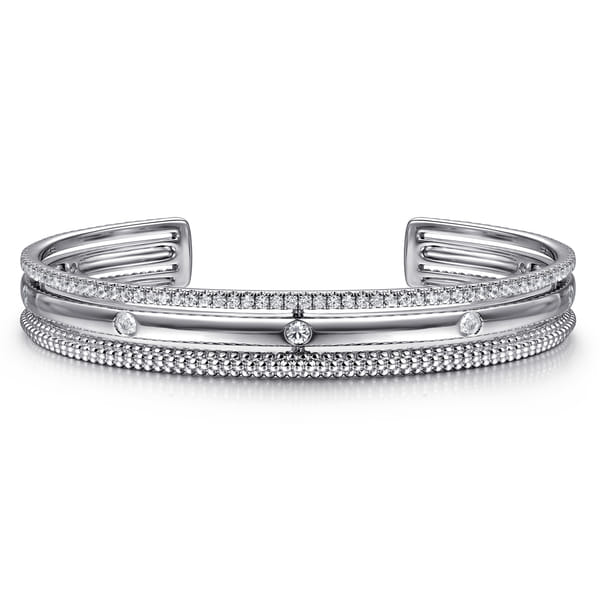
- Diamond-set / pavé bangle: Diamonds or gemstones running along the top, around the full circumference, or clustered at stations. Ranges from delicate daytime pieces to bold evening statements.
- Stackable / 'banglet': Ultra-slim bangles designed specifically to be worn in multiples. Often sold in sets. The fastest way to build wrist presence.
How to Size a Bangle
How to Size a Bangle
Because a bangle has no clasp and must pass over the knuckles, sizing is crucial and specific to the bangle category. Here is how to do it right:
- Make a cone with your hand: bring all four fingers together and tuck your thumb against your palm. This creates the narrowest shape your hand can make.
- Measure at the widest point: Use a soft measuring tape around your knuckles in the cone position.
- Add 1–1.5 cm: for comfortable wear. That is your bangle circumference size. Between sizes? Always go up.
For open or split bangles, sizing is far more forgiving. The gap eliminates the hand-passing challenge entirely, making it a great entry point for first-time bangle buyers. For a full breakdown of sizes, download the Gabriel & Co. Bracelet Size Guide.
The Art of Bangle Stacking
Bangle stacking is one of those skills that looks effortless once someone knows the rules, and then liberating once they feel confident enough to break them. Here are the principles that actually hold:
Start with a hero piece
Every great stack needs an anchor; one piece that sets the tone. It might be a diamond-station bangle, a meaningful gift, or simply the piece you reach for first. Everything else builds around it in contrast: different widths, different textures, different levels of sparkle.
Odd numbers read best
Three, five, and seven tend to look more intentional than two or four. Odd stacks create natural asymmetry and rhythm. A single bangle worn alone is also always correct; the lone statement piece has its own quiet authority.
Vary the texture
A polished plain band next to a beaded bangle next to a pavé-set piece. That combination of smooth, textured, and sparkling is the visual equivalent of rhythm. All-uniform stacks can feel flat; contrast gives depth.
On mixing metals
Yes, you can, and in 2026, you should feel entirely free to. Let one metal dominate (roughly 60% of the stack) and let others play supporting roles. Many Bujukan pieces are two-tone by design, making them natural bridges between yellow and white gold bangles in a mixed stack.
Stacking with a watch
Your watch is not an obstacle; it is your anchor. Cluster bangles on the same wrist, or distribute them on both. Slim bangles tend to coexist most comfortably alongside a watch face; avoid overly thick stacks that compete with the dial.
How to Style Bangles for Every Occasion
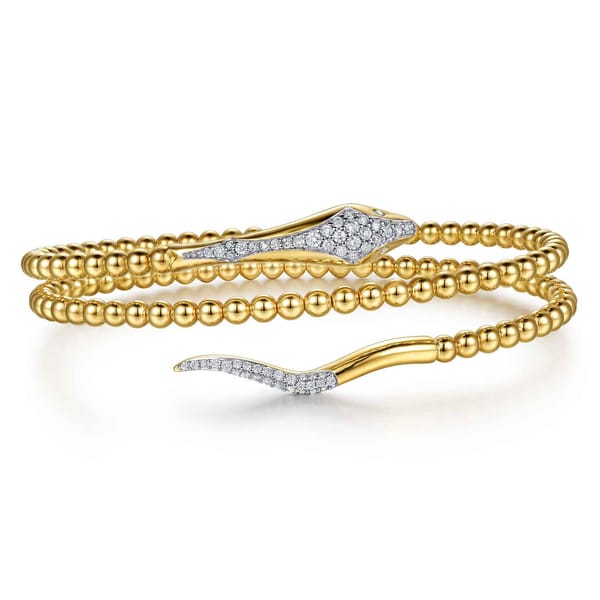
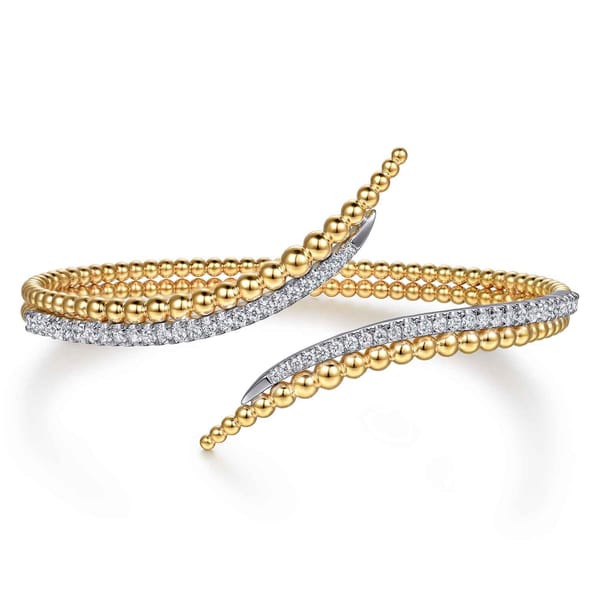
Everyday: Two to three slim bangles: one with enamel, one textured, one lightly diamond-accented. The Bujukan open bangle is the perfect daily companion: lightweight, comfortable, and beautiful enough to feel intentional without trying.
Work: A contained stack of three. Keep metal tones coherent and avoid heavy chinking. Fine bangles complement professional attire; a messy stack distracts from it.
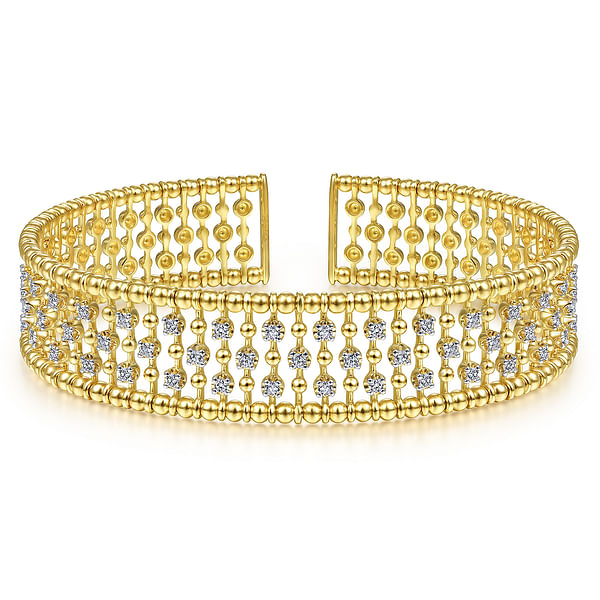
Evening: This is when you reach for diamond presence. Fewer, bolder pieces on a bare wrist can hit harder than a crowded stack. One statement Bujukan cuff with a plain companion is a quietly devastating combination.
Resort / festival: Full maximalism. Stack seven, eight, twelve bangles. Mix fine pieces with casual, maybe colorful ones. This is where the form is most joyful, and most itself.
The Bujukan Collection: Gabriel & Co.'s Most Loved Bangles
If there is one collection that defines how Gabriel & Co. thinks about bangles, it is Bujukan, and the story behind it is as good as the jewelry itself.
Where it came from
Launched in November 2019, the collection was born from a sculpture on Dominick Gabriel's desk, a cascading arrangement of silver spheres gifted by his wife. "I kept looking at these beautiful spheres that were static but seemed as if they were in movement. They were elegant, polished and full of joy and life." Those spheres became the DNA of the entire collection: hand-crafted gold beads that move with the wrist and catch light in a way that feels alive.
The name
'Bujukan' is an Indonesian and Balinese word meaning persuasion; the gentle art of enticing, of drawing someone in through subtlety rather than force. It is the perfect name for jewelry that never shouts, yet consistently earns the compliment. When you know you're irresistible, why shout?
What makes it different
What sets Bujukan apart is the craftsmanship: gold beads that are built, not cast, for a texture that feels as exceptional as it looks; flexible internal engineering for all-day comfort; and diamond accents placed to enhance the gold rather than overpower it. The collection spans Bujukan bangles, rings, earrings, necklaces, and pendants, all speaking the same beaded language, all in 14K gold, all backed by Gabriel & Co.'s lifetime warranty.
"Hidden in every bead is a story waiting to be told."
Start with one piece. You will know immediately why people keep adding to their stack.
FAQs
What is the difference between a bangle and a bracelet?
A bangle is rigid and holds its shape with no clasp or flexible links. A bracelet is a broader category that includes chains, tennis styles, charm bracelets, and more. The bangle's defining quality is structure: metal that keeps its form on the wrist without any fastener.
Which wrist should you wear bangles on?
There is no rule. Most people wear bangles on their non-dominant hand for comfort, but personal preference and cultural tradition both play a role. The only real guideline: if you wear a watch, decide whether you want your bangles on the same wrist for a stacked effect, or spread across both.
How many bangles should I stack?
Three to five is the sweet spot for an intentional-looking stack. One worn solo makes a clean statement. More than seven is deliberate maximalism. Trust your instinct.
Can you mix metals when stacking bangles?
Yes, and in 2026 you should feel free to. Let one metal dominate and let others support. Many Bujukan pieces are two-tone by design, making them natural bridges in a mixed stack.
Can you wear bangles every day?
Absolutely. Bangles are built for daily wear. Choose 14K gold for durability, and open or split styles for ease. The Bujukan collection was designed exactly for this: flexible, comfortable, and refined enough for morning to evening.
How do I find my bangle size?
Tuck your thumb into your palm, bring your fingers together, and measure around your knuckles. Add 1–1.5 cm for comfortable wear. Between sizes, always go up.
How do you keep bangles from sliding off?
Sizing is the main factor. A bangle that fits correctly will sit above the wrist bone naturally. If your bangles slide, try a smaller size or stack multiple pieces together, as grouped bangles tend to stay in place better than a single loose one.