Good to Have You Back

A radiant cut diamond is a rectangular or square-shaped diamond with trimmed corners and a brilliant-style facet pattern covering both its crown (top) and pavilion (bottom). It was patented in 1977 by diamond cutter Henry Grossbard, and it remains one of the most sought-after fancy shapes in fine jewelry today.
Before the radiant cut existed, shoppers faced a real trade-off. Round brilliant diamonds offered unmatched sparkle, but only one shape. Fancy cuts like the emerald and Asscher were elegant and architectural, but their step-cut facets produced a much quieter light performance. Grossbard's breakthrough was applying the full brilliant-cut facet structure to a rectangular outline, producing a fancy-shape diamond that could genuinely rival the round brilliant for fire and scintillation.
The result is a diamond that offers shape versatility without sacrificing brilliance. No other fancy cut achieves that balance quite as effectively. Browse our full collection of radiant cut engagement rings to see the shape across a range of settings, metals, and styles.
How the Radiant Cut Is Designed
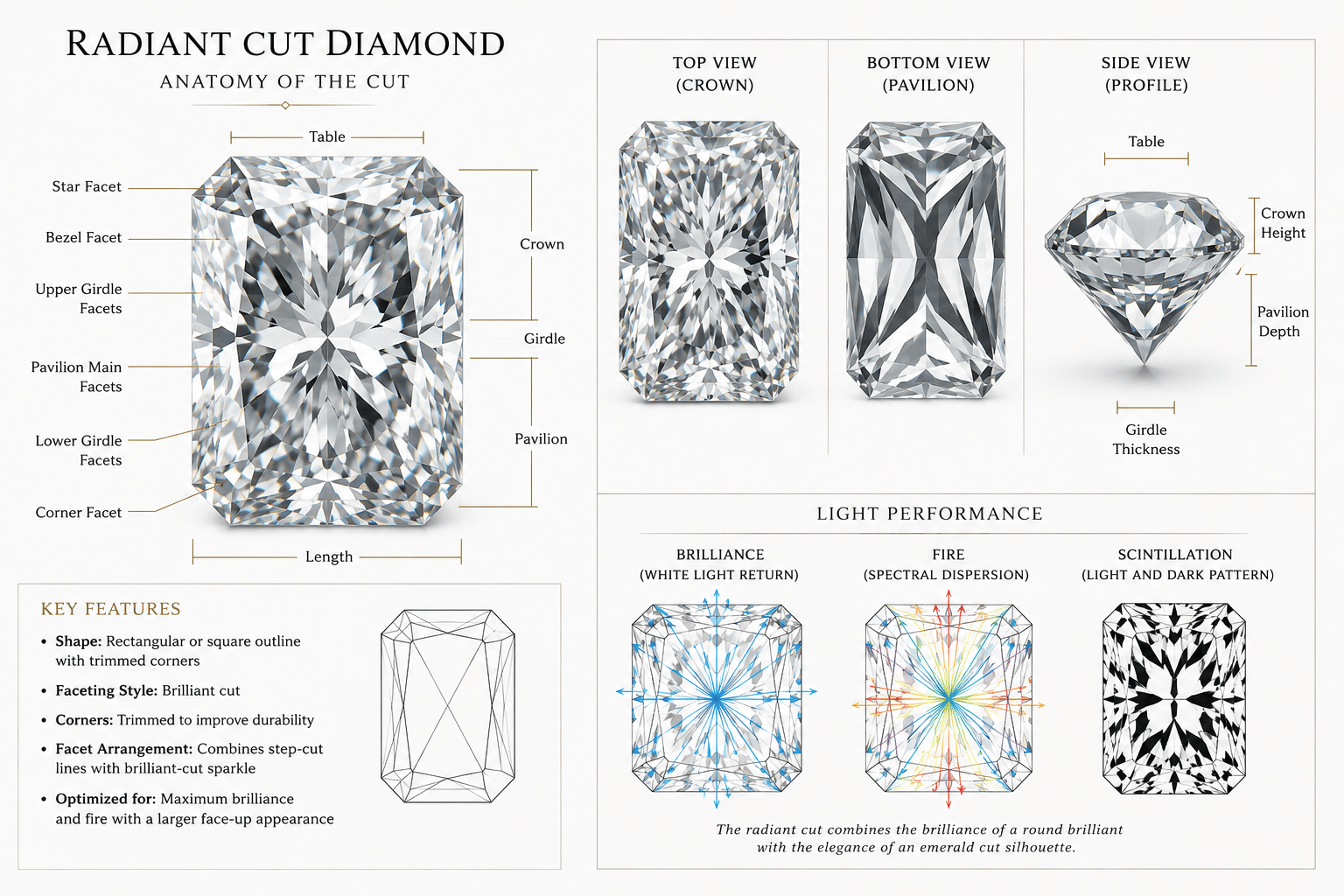
The radiant cut typically features 70 facets, arranged using the same brilliant-cut facet pattern that gives round diamonds their exceptional sparkle. These facets are distributed across three primary areas of the diamond:
- Crown (top): 25 facets, including the table, star facets, and bezel facets, designed to capture and disperse incoming light.
- Girdle: The outer edge that separates the crown from the pavilion and contributes to the diamond’s durability.
- Pavilion (bottom): 37 facets that reflect light back through the crown, creating the radiant cut’s signature brilliance and fire.
One of the radiant cut’s defining characteristics is its trimmed corners. Unlike pointed-corner rectangular shapes, which can be vulnerable to chipping, the radiant cut’s cropped corners improve durability while creating its distinctive balanced silhouette.
The combination of brilliant-cut faceting and a rectangular outline produces a lively scintillation pattern with intense sparkle and contrasting flashes of light. Many radiant cuts display a soft “crushed ice” appearance, making the shape one of the most visually dynamic fancy-cut diamonds available.
What to Look for in a Radiant Cut Diamond
The Gemological Institute of America does not assign an overall cut grade to radiant cut diamonds the way it does for round brilliants. Because there is no single set of universally agreed-upon ideal proportions for fancy shapes, cut quality for a radiant must be evaluated through a combination of proportion measurements, symmetry ratings, and visual inspection.
The following ranges serve as a useful starting point when evaluating a radiant cut diamond:
| Specification | Ideal Range | What It Means |
| Length-to-width ratio | 1.00 to 1.35 | 1.00 to 1.05 reads as square; 1.20 to 1.35 reads as rectangular |
| Depth percentage | 61% to 67% | The sweet spot for optimal light return |
| Table percentage | 61% to 69% | Avoid extreme highs or lows |
| Girdle thickness | Thin to slightly thick | Very thick girdles add carat weight without visual benefit |
| Clarity grade | VS2 to SI1 | Brilliant facets scatter light and mask most inclusions |
| Color grade | G to J | Color tints are less visible than in round brilliants |
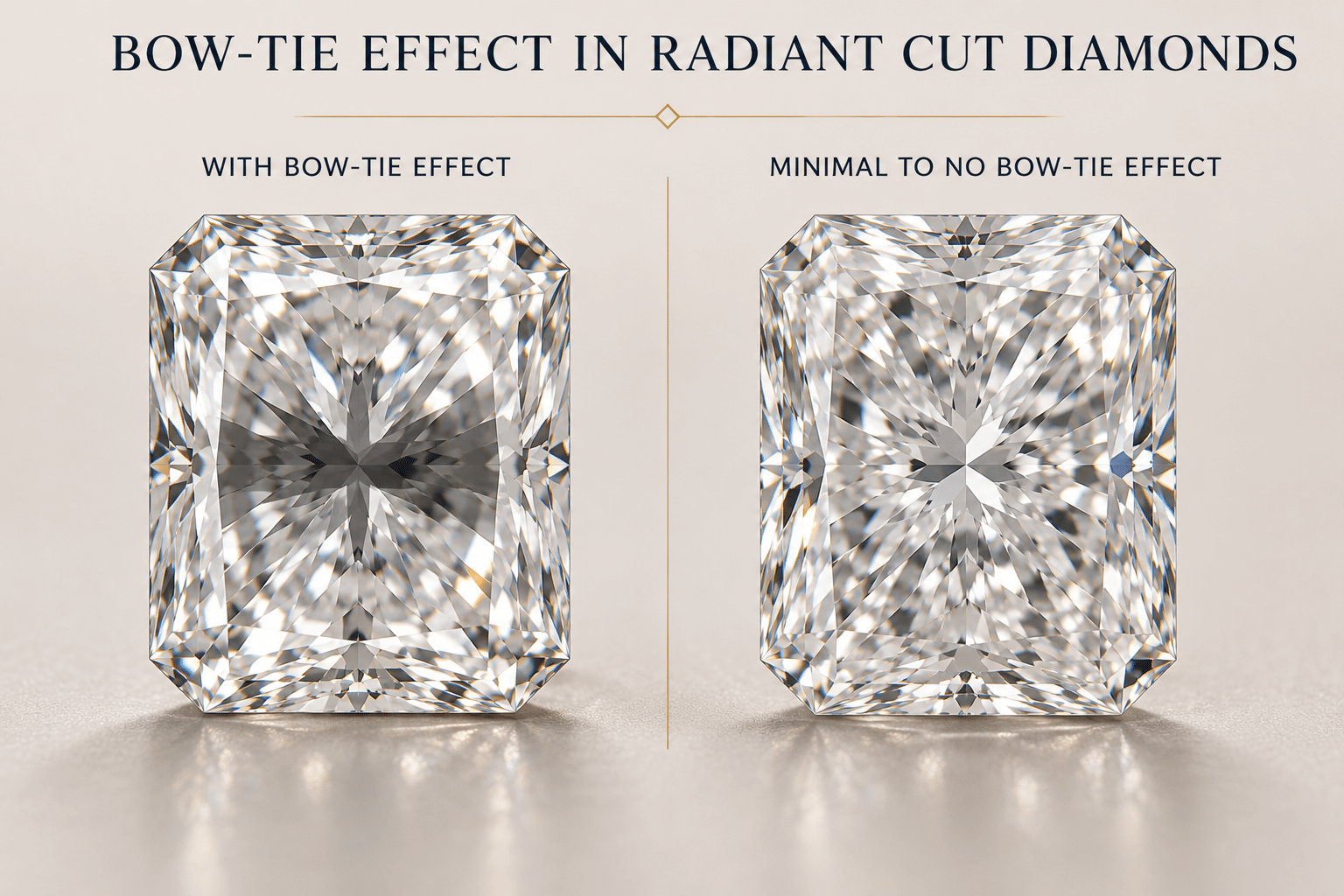
Because the brilliant facet pattern breaks up inclusions visually, radiant cut diamonds tend to look cleaner face-up than their clarity grade might suggest. This makes them a practical choice for buyers who want to maximize size and brilliance within a given budget.
Color is also less visible in a radiant than in a round brilliant, particularly in G to J range stones set in yellow or rose gold. The facets scatter light in a way that minimizes the appearance of any warm tint.
Radiant Cut vs. Similar Diamond Shapes
The radiant cut is often compared to other rectangular or square fancy shapes. Here is how it differs from its two closest alternatives:
| Emerald Cut | Radiant Cut | Princess Cut |
| Step-cut | Brilliant-cut | Brilliant-cut |
| Serene, reflective | Maximum fire and scintillation | High brilliance |
| Very high | Forgiving | Moderate |
| Cropped | Trimmed | Sharp, pointed |
| Architectural elegance | Brilliance in any shape | Modern square look |
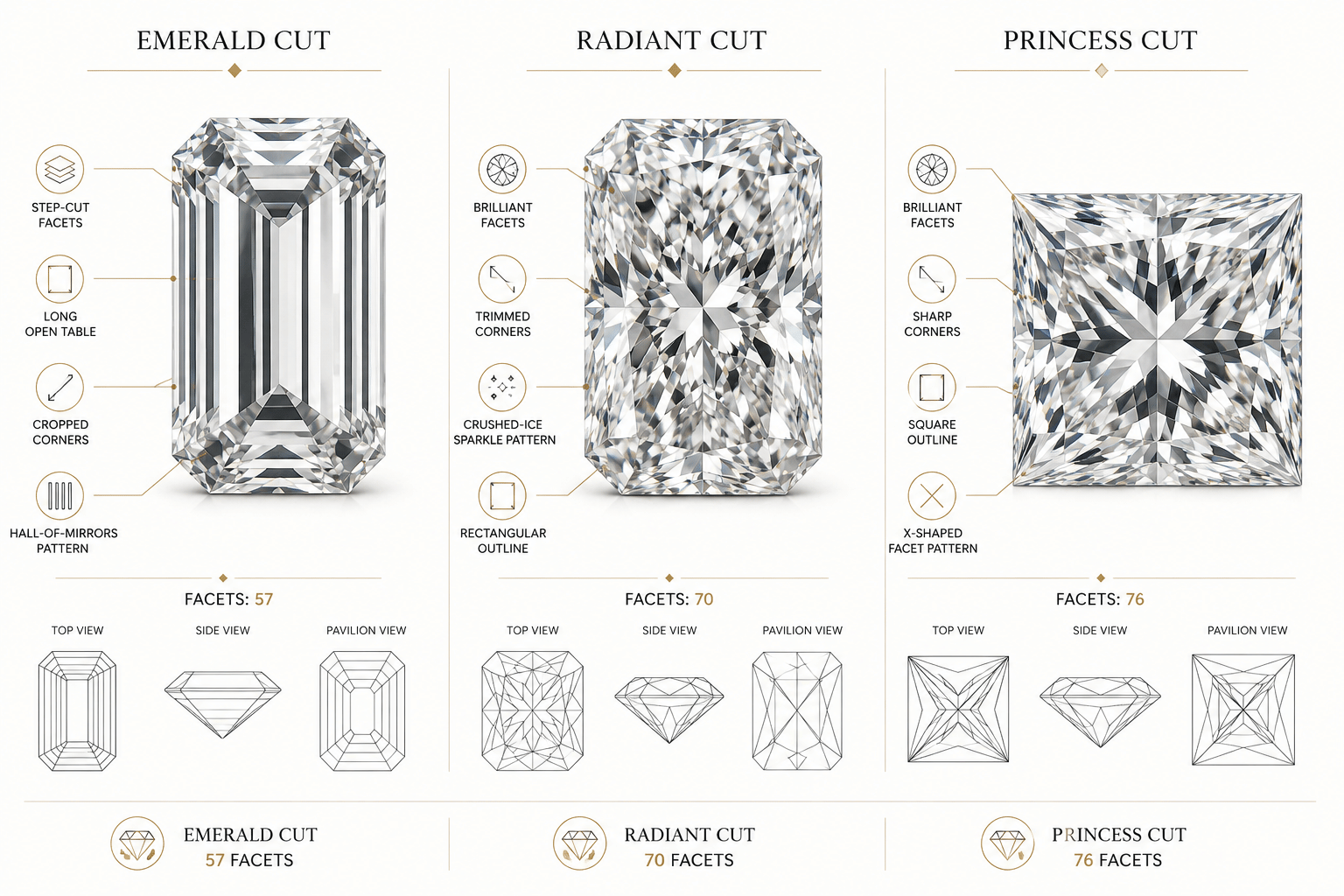
The most important distinction is between the radiant and the emerald cut. Both are rectangular with cropped corners, and they are frequently confused. The difference lies entirely in the facet structure. In an emerald cut engagement ring, the diamond features step-cut facets that produce long, parallel reflections and a calm, glassy appearance. A radiant cut uses brilliant-cut facets that produce dynamic, multi-directional sparkle. The look and feel of the two stones are very different.
Compared to a princess cut engagement ring, the radiant offers a safer corner profile. The princess cut's sharp corners require protective prong settings and are more prone to chipping. The radiant's trimmed corners are more durable and easier to set in a wider range of ring styles.
For in-depth comparisons, check out our guides on Radiant vs. Cushion Cut and Radiant vs. Emerald Cut.
How to Wear a Radiant Cut Diamond
The radiant cut is one of the most versatile fancy shapes available. Its trimmed corners and symmetrical outline work well across a wide range of setting styles, metal choices, and ring designs. The sections below cover the most popular ways to wear a radiant cut diamond and how to pair each setting with the right wedding ring.
The Solitaire
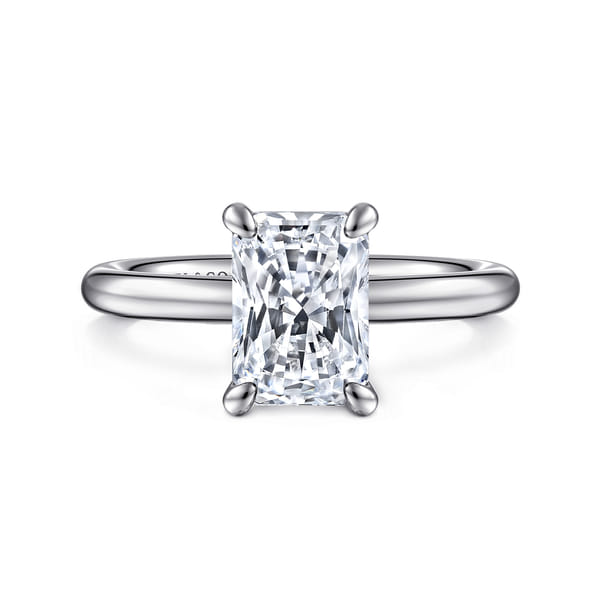
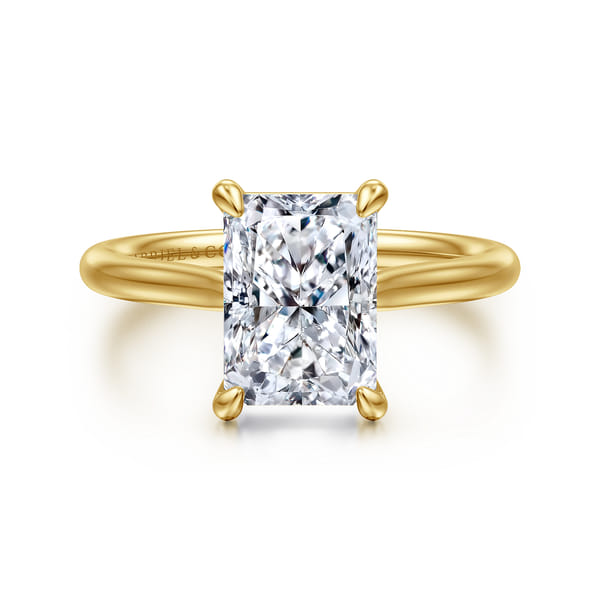
A solitaire engagement ring places the center stone on a plain or lightly detailed band with no surrounding stones. It is the most direct way to wear a radiant cut diamond, and it works because the cut already produces exceptional brilliance on its own. There is nothing to compete with the stone.
In yellow gold, a solitaire radiant cut reads warm and classic. In white gold or platinum, the look becomes cleaner and more contemporary. Both work for long-term, everyday wear.
Recommended wedding band
Solitaires pair most naturally with a simple matching band or a curved wedding band that sits flush against the engagement ring's setting. A straight diamond band also works well if you want to add sparkle post-wedding without changing the look of the solitaire itself.
The Bezel Setting
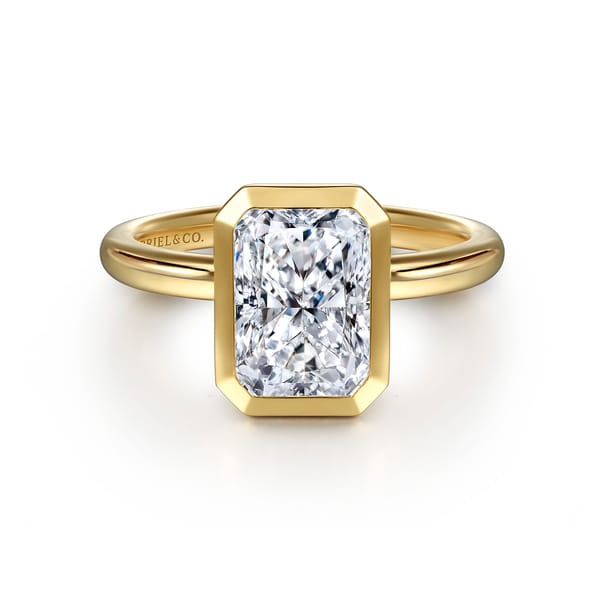
A bezel-set engagement ring wraps a thin metal frame around the entire perimeter of the center stone. It is one of the most secure settings available and one of the most practical for everyday wear. The radiant cut's trimmed corners make it especially well suited to a bezel, which traces the stone's outline cleanly on all sides.
Yellow gold bezels are currently one of the strongest trends in radiant cut styling and suit a wide range of color grades.
Recommended wedding band
The bezel's clean metal rim gives the ring a modern, graphic quality that pairs well with a flat or low-profile wedding band. A seamless straight band in the same metal is the most cohesive pairing. Stackable bands work well too, particularly if you prefer a more layered look over time.
The Halo Setting
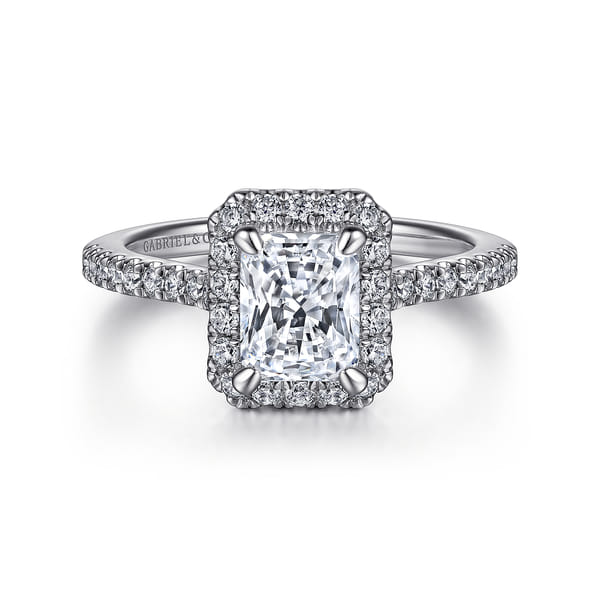
A halo surrounds the center stone with a frame of smaller diamonds. For a radiant cut, a rectangular halo that follows the shape of the stone is the most natural choice. It extends the visual size of the ring and adds sparkle that reinforces rather than distracts from the center diamond.
Halo engagement rings tend to read as more traditional and occasion-appropriate, and it photographs very well.
Recommended wedding band
Halo settings work well with diamond-set shanks, where additional stones continue down the band for a fuller, more detailed look. If you prefer a cleaner band, a plain or milgrain-edged shank brings the focus back to the center. A curved or notched wedding band is the most practical pairing, designed to sit flush alongside the halo's profile.
The Hidden Halo
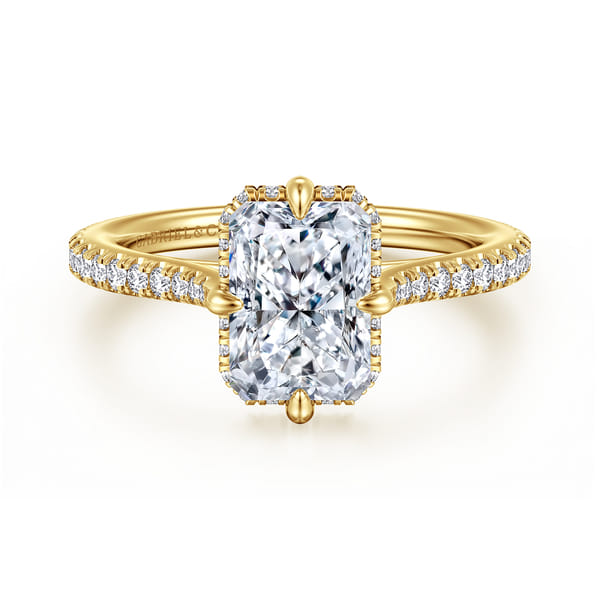
Compass prong placement, where the four prongs are positioned at the corners of the stone rather than its sides, is a contemporary variation that emphasizes the radiant's geometric shape and gives the setting a more distinctive look from above.
Recommended wedding band
In a hidden halo engagement ring, a row of diamonds is hidden just beneath the girdle of the center stone, visible from the side and at an angle but not immediately obvious when looking straight down at the ring. The face-up appearance stays clean and solitaire-like, while the side profile adds unexpected detail and dimension.
A straight eternity wedding band pairs well with this style, continuing the sparkle from the hidden halo down the shank. A plain band keeps the focus on the subtle detail of the hidden row itself.
The Three-Stone Setting
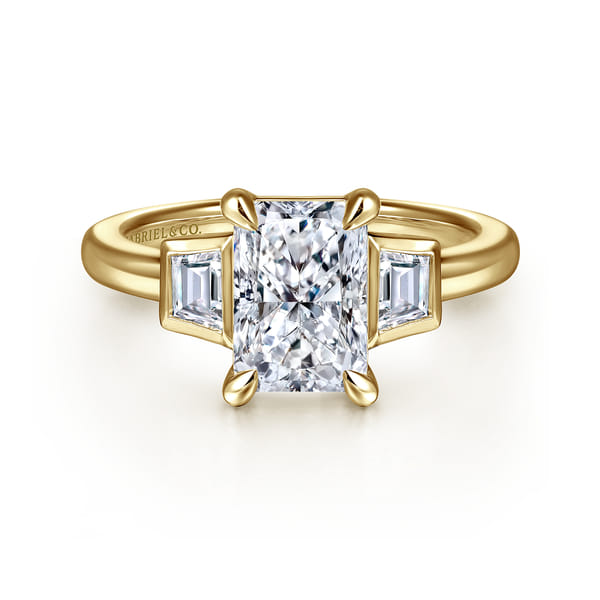
A three-stone setting places the radiant cut center diamond between two side stones. Trapezoid side stones are the strongest pairing for a radiant cut. Their angled sides echo the trimmed corners of the center stone and create a continuous, cohesive line across the width of the ring.
Three-stone engagement rings carry traditional symbolism representing past, present, and future, which makes them a meaningful choice for an engagement ring. They also add significant diamond weight and visual presence without requiring a larger center stone.
Recommended wedding band
Wedding band pairing requires more consideration with a three-stone setting because the side stones extend the footprint of the ring. A slim, flat band, an open wedding band or a custom contoured band designed to sit alongside the setting works best. Many three-stone styles have a matching band available.
Metal Choice and Proportions
Radiant cut diamonds are available in all metal types at Gabriel & Co. Yellow gold is particularly well suited to G-J color diamonds because the warm tone reduces the visibility of any color in the stone. White gold and platinum create a cooler, more neutral backdrop that lets the diamond's brilliance read clearly.
Length-to-width ratio shapes how the diamond appears on the finger. A ratio between 1.00 and 1.05 gives a near-square look. Between 1.20 and 1.30 is the most popular rectangular range and tends to elongate the finger visually. Ratios above 1.35 give a more dramatically elongated silhouette.
All Gabriel & Co. engagement rings can be configured in your preferred metal. Speak with one of our retailers for guidance on center stone sizing, metal options, and matching wedding bands.
FAQs
Is a radiant cut the same as a princess cut?
No. Both are available in square and rectangular shapes, but they are quite different. A princess cut has sharp, pointed corners and a specific pavilion structure. A radiant cut has trimmed corners and a fully brilliant-cut facet arrangement on both the crown and pavilion. The two cuts also look noticeably different in person.
Does a radiant cut look bigger than a round diamond of the same carat weight?
Often, yes. Radiant cuts tend to have a larger face-up surface area relative to their carat weight compared to round brilliants. This is because their weight is distributed more evenly across a flatter, wider profile. A 1.00 carat radiant typically measures around 5.5 by 5.0 millimeters, while a 1.00 carat round measures approximately 6.4 millimeters in diameter.
Why does GIA not give radiant cuts an overall cut grade?
The GIA cut grading system was built around the round brilliant, where mathematical modeling can identify a clear set of ideal proportions. For fancy shapes like the radiant, ideal proportions vary depending on the stone's dimensions and the buyer's preferences, so there is no single standard to grade against. GIA reports symmetry and polish grades for radiant cuts, but overall cut quality is left to the buyer to assess visually.
Are radiant cut diamonds less expensive than round brilliants?
Generally, yes. Radiant cuts are typically priced 20 to 30 percent lower per carat than round brilliants at comparable quality grades. This reflects both the higher material yield during cutting and the difference in consumer demand, which continues to favor round diamonds at the top of the market.
What is the best length-to-width ratio for a radiant cut engagement ring?
This comes down to personal preference. A ratio between 1.00 and 1.05 gives a square appearance. A ratio between 1.20 and 1.30 is the most popular range for a classic rectangular look. Ratios above 1.35 give a more elongated silhouette that some wearers find very flattering.
Can a radiant cut diamond show color?
All diamonds can show color, but the radiant's brilliant facet pattern distributes and scatters light in a way that makes color less visible than in step-cut shapes. For most buyers, a G to J color grade will appear near-colorless face-up in a well-chosen setting, especially in yellow or rose gold.